Showing posts with label money. Show all posts

Thursday, December 16, 2010

Chinese rush to gold as inflation fears bite

While recent statistics show that China's gold imports have risen dramatically this year, despite China itself being the world's largest gold producer with mine production still rising to, anecdotal evidence suggests that this may just be the tip of the iceberg as Chinese people are, apparently, rushing to buy gold as an inflation hedge.

A report in the Financial Times suggests that gold purchasing by individuals is turning into such a rush - and the rising price, if anything, is - contrary to Indian experience - fuelling the intensity of gold demand there.  With the ever-rising growth in the numbers of middle-income Chinese as the country's wealth drips down to the people, this source of gold demand is becoming increasingly relevant to the global market.  China is expected to surpass India as the world's leading gold purchaser within the next few years and with the kind of surge in popularity of gold bars and coins, rather than jewellery, there this could even take place sooner rather than later.

As an indicator of the kind of demand being seen in China, FT Reporter Leslie Hook notes in a despatch from the Chinese capital: "At Beijing's largest gold shop, the queues to buy bullion mini bars have turned into scrums as customers jostle for one of the country's hottest commodities. The phone behind the bullion counter rings off the hook as a frantic sales clerk tries to answer buyers' questions. The electronic chart displayed behind him says it all: the price of gold is rising and Chinese investors, worried about inflation, want in on the trend."

For the global gold market this is very significant as momentum in the Western gold market appears to have slowed dramatically.  As Mineweb writer Rhona O'Connell noted yesterday (see: Gold ETF momentum slows above $1,300 - can silver investment be sustained?) since gold hit around $1300 an ounce ETF inflows and outflows have been broadly in parallel, and it has probably been ETF demand which has been the principal demand driver for gold over the past few years.  Gold and silver bullion sales also seem to be slowing in the west as confidence in economic recovery, however unjustified, is beginning to return and people are looking elsewhere to invest.

What is interesting about the Chinese experience is that the apparently huge demand from the public - initially stimulated by state institutions (see: China pushes silver and gold investment to the masses ) - is due to fear of inflation.  Maybe the Chinese are more sophisticated in economic theory than their Western counterparts, but the levels of new money being pushed into the Western (and Japanese) economies by government has to have severe inflationary consequences down the road.  It's just the Western general population hasn't yet understood this consequential result.  Give them time!  In China inflation is already beginning to impact as the western stimuli are beginning to raise inflation in China rather than in their home countries - so far.

Most western observers also believe that the Chinese state is absorbing all of that country's gold production and taking it into reserves - even if this is not actually being reported in official statistics, but being held in an account other than that of the Central Bank until China chooses to make the information public.  What this means is that a whole hunk of global production is not appearing on the open market, which effectively tightens supplies.  Taken together with the surge in Chinese demand this will have a serious impact on what becomes available on the open market - and with some Central banks having become buyers - and a dearth of sellers from this source - gold's fundamentals would seem to be altering in favour of continuing price rises for the metal.

China's burgeoning demand is now likely to continue to build - at least until the Chinese New Year (which begins on February 3rd next year) - and will help to maintain the gold price at or around the current level or better.  Indeed with Western activity already beginning to wind down ahead of the Christmas and Western New Year holidays making trading thin in New York and London, there could be a positive impact on price developing by the calendar year end.

Need A Job? Too Bad! The Good Jobs Are Being Shipped Out Of America As Part Of The New One World Economy

I hope that you enjoy the cheap foreign-made plastic trinkets that you will be exchanging with your family and friends this holiday season, because they are literally destroying the U.S. economy.  As part of the new "one world economy" that both Democrats and Republicans insist is so good for us, millions of good paying middle class jobs have been shipped out of America.  Do you need a job?  Are you wondering where all the good jobs went?  Well, the next time you are out just walk into a store and start looking at the product labels.  Most of the things that are sold in our stores are now made out of the country.  So if you need a good paying job to support your family that is just too bad - you have been merged into a global labor pool where you must compete for jobs with people on the other side of the globe willing to work for less than a tenth of what you usually make.  Welcome to the "one world economy" where big global corporations make a fortune exploiting slave labor on the other side of the world while "overly expensive American workers" get dumped out on the street.

Are you in favor of a redistribution of wealth?  Most of the time when the phrase "redistribution of wealth" is brought up, conservatives and libertarians visibly cringe - as they should.  But did you know that right now the greatest redistribution of wealth in the history of the world is taking place and our politicians are doing nothing about it?

For a moment, imagine a giant map of the world.  On that giant map, put a huge pile of money on the United States, and also put a huge pile of money on China and on the OPEC nations.  Now imagine a big hand coming along once a month that takes tens of billions of dollars out of the U.S. pile and puts it into the piles of China and the OPEC nations.


As this continues month after month after month, what is eventually going to happen?

The U.S. pile of money is going to get far smaller and the other piles of money are going to get much, much larger.

And that is exactly what is happening in our world today.

Back in 1985, the U.S. trade deficit with China was 6 million dollars for the entire year - not really anything to worry about  it.

Well, let's fast forward to 2010.  For the month of August alone, the trade deficit with China was more than 28 billion (that's billion with a "b") dollars.

In other words, the U.S. trade deficit with China in August was more than 4,600 times larger than the U.S. trade deficit with China was for the entire year of 1985.

My, how the world has changed in 25 years.

Oh, but doesn't China "invest" some of that money they are getting from us back into our country?
Well yeah, our top officials regularly go over there to beg them to lend us more money.  Now we owe China close to a trillion dollars.  We also owe the major oil exporting nations of the Middle East massive amounts of money.

Is this a good idea?  Let us keep in mind the ancient principle that the borrower always ends up the servant of the lender.

Is it wise for the United States to become enslaved to China and to the oil exporters of the Middle East?
Is that any way to run an economy?  Is that any way to run a country?

All over the United States factories are closing down.  If you go to shopping centers in many areas of America you would think that the hottest new store was called "Space Available".

Since the year 2000, we have lost 10% of our middle class jobs.  In the year 2000 there were about 72 million middle class jobs in the United States but today there are only about 65 million middle class jobs.
What kind of progress is that?

"But oh", the supporters of the one world economy will declare, "the cheap goods, the cheap goods!"
Yes, I hope you enjoy paying ten percent less for your plastic trinkets.  But you will also support American workers one way or another.  Either you will provide them with good paying jobs, or you will pay for their food stamps and their unemployment checks.

One out of every six Americans is now enrolled in a federal anti-poverty program.  As 2007 began, 26 million Americans were on food stamps, but now 42 million Americans are on food stamps and that number keeps rising every single month.

Can anyone out there please explain how the "one world economy" is supposed to be good for us when 42 million Americans cannot even feed themselves?

Allowing our country to be deindustrialized just so that we can consume more cheap goods from China is like tearing down pieces of your house to keep your fire going.  In the end, you won't have much of a house left.
Whatever your opinion of Donald Trump is, this next video is worth watching.  Trump certainly should not run for president, but as a savvy businessman he definitely understands what China is doing to us....


It is time for the American people to wake up.

We are being taken advantage of. The one world economy is going to keep destroying the U.S. middle class.  There is no way that American workers can compete with slave labor on the other side of the globe.  It is impossible.

In fact, just about every kind of job imaginable is being shipped to places where labor is cheaper.  Even engineering and computer programming jobs are being offshored and outsourced.

The United States is even being slaughtered in high-tech industries.  Back in 1998, the United States had 25 percent of the world’s high-tech export market and China had just 10 percent. Ten years later, the United States had less than 15 percent and China's share had soared to 20 percent.

According to one recent study, China could become the global leader in patent filings by next year.
The United States has become a bloated, slovenly nation that consumes massive amounts of wealth but that produces relatively little.

With each passing year, we make fewer things inside the United States....

*The United States has lost a staggering 32 percent of its manufacturing jobs since the year 2000.
*Since 2001, over 42,000 U.S. factories have closed down for good.

*As of the end of 2009, less than 12 million Americans worked in manufacturing.  The last time that less than 12 million Americans were employed in manufacturing was in 1941.

*Manufacturing employment in the U.S. computer industry is actually lower in 2010 than it was in 1975.
*In 2010, the number one U.S. export to China is "scrap and trash".

Oh, but won't "getting more education" solve all of our problems and get the American people back to work?
No.

The truth is that tens of millions of Americans have a "higher education" that is not doing them any good today.
In his article entitled "The Great College-Degree Scam", Richard Vedder explains that a large percentage of U.S. college graduates are working in jobs that have not historically required college degrees....
Here it is:  approximately 60 percent of the increase in the number of college graduates from 1992 to 2008 worked in jobs that the BLS considers relatively low skilled—occupations where many participants have only high school diplomas and often even less.
Ouch.
Later on in his article, Vedder notes that the number of college graduates that are waiting tables or that are working as cashiers is absolutely exploding....
In 1992 119,000 waiters and waitresses were college degree holders. By 2008, this number had more than doubled to 318,000. While the total number of waiters and waitresses grew by about 1 million during this period, 20% of all new jobs in this occupation were filled by college graduates. Take cashiers as well. While 132,000 cashiers possessed college degrees in 1992, by 2008, 365,000 cashiers were college graduates. As with waiters and waitresses, 20% of new cashiers since 1992 are college graduates.
So do you still think that the "one world economy" is a great idea?

Well, you might want to practice the following two phrases....

#1 "Would you like fries with that?"

#2 "Welcome to Wal-Mart!"

Our economy is turning into a low-wage service economy because we don't make much of anything in the United States anymore.

So if you need a good job, I am afraid that the joke is on you.

The good jobs are being shipped out of the United States as part of the new one world economy, and millions of unemployed Americans have been left to fight over the low paying service jobs that remain.

So if you are flipping burgers or stocking shelves for a big multinational retail chain, perhaps you should consider yourself to be fortunate.  At least you still have a job.  There are millions of desperate, hungry-eyed Americans that would take your job in a second.

And you know what?  Things are only going to get worse.

Wednesday, December 15, 2010

When Americans Lose Everything, They Start To Lose It

As Gerald Celente has often warned, when Americans lose everything, they will start to lose it, and nowhere was that more apparent than in the case of Clay Duke, the 56-year-old gunman who opened fire on school board members in protest against his wife being fired and his unemployment benefits running out.

Duke spray-painted a V for Vendetta sign on the wall before brandishing a gun and telling everyone apart from the school board members to leave the room. Watch what happened next in the video below.


The response to this tragic series of events from both the establishment left and the establishment right will undoubtedly be to try and portray Duke as a nutcase conspiracy theorist whose views are an example of why free speech on the Internet needs to be curtailed, despite the fact that both on his Facebook page and another website he recommended, Duke promoted websites from across the political spectrum, including Media Matters, who are usually the first to exploit tragic events like these to sling mud at their political adversaries.
The fact that no one was injured and that Duke ultimately claimed his own life has contributed to him becoming a martyr in the Michael Douglas Falling Down mould rather than being considered a deranged lunatic, and Facebook pages in his honor are already attracting members.

Duke was stopped when shots from a security guard wounded him, before he took his own life. Despite the fact that it was a gun that stopped the rampage, Time Magazine and others are already blaming the tragedy on the Second Amendment.

In a de-facto online suicide note posted on Facebook, Duke railed against the financial terrorists that prompted him to take such a drastic course of action
“I was just born poor in a country where the Wealthy manipulate, use, abuse, and economically enslave 95% of the population. Rich Republicans, Rich Democrats… same-same… rich… they take turns fleecing us… our few dollars… pyramiding the wealth for themselves,” he wrote. “The 95%… the us, in US of A, are the neo slaves of the Global South. Our Masters, the Wealthy, do, as they like to us…”

This goes far deeper than someone violently acting upon political grievances. Duke’s actions were solely guided by his economic woes, the fact that his wife had lost her job, that the unemployment benefits had run out, and that the future offered no hope whatsoever.

This is a future that millions more Americans will have to face in the coming years as the unemployment rate, which is really at around the 20 per cent level, continues to accelerate.

As we warned back in June, we are in the early stages of a new “age of rage,” which will be characterized by riots, revolutions and a widespread backlash against the economic holocaust that has been unleashed by the global elite.

Unfortunately there will be many more Clay Dukes over the coming years, there will be more Americans who lose everything and decide that the best way out is simply to lose it altogether.

Wednesday, December 1, 2010

As The Euro Goes The Way Of The Dodo, Where Does That Leave The Dollar?

The Eurozone is heading for a crash—anyone saying otherwise is either stoned, works in Brussels, or hasn’t checked the European bond market action lately: All hell is breaking loose there.

The Euro:
A famed, flightless bird, now extinct.
And if, as I have argued here, the Irish Parliament decides not to pass the austerity budget next December 7—that is, decides not to take the European Central Bank bailout—then hell is going to break out in Europe just in time for Christmas: Satan and Santa Claus just might be squaring off on the Rue Belliard before year’s end.

Therefore, the smart money starts thinking about what’s going to happen after the euro-crisis-climax happens.

In other words, what’s going to happen to the dollar, once the euro goes the way of the dodo.

First, we have to understand how we got here, in order to figure out what’s going to happen next.

The Banana Republics of Europe

In the 1970’s and ‘80’s, various Latin American republics foolishly pegged their currency to the U.S. dollar.
 

The Madness of a Lost Society

Friday, November 26, 2010

So What Happens If The Dollar And The Euro Both Collapse?

Some analysts are warning that the U.S. dollar is in danger of collapse because of the exploding U.S. government debt, the horrific U.S. trade deficit and the new round of quantitative easing recently announced by the Federal Reserve. Other analysts are warning the the euro is in danger of collapse because of the very serious sovereign debt crisis that is affecting nations such as Greece, Portugal, Ireland, Italy, Belgium and Spain. So what happens if the dollar and the euro both collapse? Well, it would certainly throw the current world financial order into a state of chaos, but what would emerge from the ashes? Would the nations of the world go back to using dozens of different national currencies or would we see a truly global currency emerge for the very first time?

Up until recently, the idea of a world currency was absolutely unthinkable for most people. In fact, the notion that all of the major nations around the globe would agree to a single currency still seems far-fetched to most analysts. However, if enough "chaos" is produced by a concurrent collapse of the U.S. dollar and the euro, would that be enough to get the major powers around the world to agree to a new financial world order?

Let's hope not, but it is getting hard to deny that we are heading for a major currency crisis, and if the U.S. dollar and/or the euro collapse, the world will certainly never be the same afterwards.

In case you missed it, China and Russia made a very big announcement the other day.

They told the world that instead of using the U.S. dollar to trade with each other, they will now be using their own national currencies.

Most Americans don't realize it, but that is a very, very big deal.

The fact that the U.S. dollar has been the primary reserve currency of the world for decades has given the United States a tremendous amount of economic power.

But now nations are beginning to lose confidence in the U.S. dollar and they are slowly starting to move away from it.

When the Federal Reserve announced a new round of quantitative easing in early November, it created a huge backlash from other nations. For decades, many other countries have been heavily investing in dollar-denominated assets, and now they are quite upset that those assets are going to be devalued.

Chinese Finance Vice Minister Zhu Guangyao used very strong language in denouncing the Fed's new quantitative easing scheme earlier this month....

"As a major reserve currency issuer, for the United States to launch a second round of quantitative easing at this time, we feel that it did not recognize its responsibility to stabilize global markets and did not think about the impact of excessive liquidity on emerging markets."

German Finance Minister Wolfgang Schäuble was even more blunt. He has called current Federal Reserve policy "clueless", and he says that he is absolutely disgusted with the Federal Reserve at this point....

"They have already pumped an endless amount of money into the economy via taking on extremely high public debt and through a Fed policy that has already pumped a lot of money into the economy. The results are horrendous."

So where is all of this going?

If the Federal Reserve keeps flooding the system with new dollars, the rest of the world could eventually totally reject the U.S. dollar and U.S. Treasuries.

If that day ever arrives, the results would be beyond catastrophic as the following short video from the National Inflation Association demonstrates....

But it is not just the U.S. dollar that is in trouble.

The euro is in danger as well.

Just consider the financial problems that some major European nations are experiencing right now....

*Standard & Poor's has slashed Ireland's credit rating two notches to "A", and is warning that there could be further downgrades. The Irish budget deficit is projected to reach 32 percent of national output this year. Ireland's finances are being called "just one big pyramid scheme", and they recently accepted a huge European bailout. Unfortunately for Ireland, this bailout comes with strings. The Irish government is now being forced to implement an austerity program that is being referred to as "draconian".

*Analysts are projecting that Portugal is going to need a bailout of at least 50 billion euros. The government of Portugal has implemented some harsh austerity measures in an attempt to get the red ink under control, and the people are not pleased. On Wednesday, a massive national strike shut down travel and basic services across the country.

*Things are so bleak in Portugal right now that Foreign Affairs Minister Luis Amado recently stated that his nation "faces a scenario of exit from the euro zone" if a solution is not found for this financial crisis.

*Greece was the first nation to need a European bailout, and now there are rumors that they may need even more assistance. The statistics agency for the EU, Eurostat, recently revealed that Greece's budget deficit for 2009 was actually 15.4% of GDP rather than 13.6% of GDP as originally thought. The Greek national debt is now well over 120 percent of GDP. The financial problems in Greece never seem to stop.

*Belgium's debt has reached 100 percent of annual national income, and the cost of insuring that country's debt has now hit record levels.

*Even Spain is in trouble. Rates on Spanish 10-year government bonds have risen to frightening heights in recent days, and the official unemployment rate in Spain is hovering around 20 percent.

*In a recent article entitled "A Spanish Bailout Would Test Europe’s Strained Finances", the New York Times quoted Jordi Galí, the director of the Center for Research in International Economics at Barcelona’s Pompeu Fabra University as saying that rumors that Spain is in financial trouble could end up making it a self-fulfilling prophecy....

"If investors expect Spain to have trouble refinancing its debt, now or somewhere down the road, then Spain will have trouble,” he added. “This is only aggravated by the fact that the reluctance of investors to purchase the country’s public debt leads to an increase in the interest rate it has to pay and thus in the budget deficit and the amount of debt it has to issue."

So could this sovereign debt crisis actually cause the euro to collapse?

Well, it depends who you ask.

European Financial Stability Fund chief Klaus Regling says that there is "zero" chance that the euro will collapse....

"There is zero danger. It's inconceivable that the euro would collapse."

Other European leaders are not so sure about that.

EU President Herman Van Rompuy recently warned that if some of the weaker countries in Europe are forced to abandon the euro it will likely cause a total meltdown of the European Union....

"We’re in a survival crisis. We all have to work together in order to survive with the euro zone, because if we don’t survive with the euro zone we will not survive with the European Union."

German Chancellor Angela Merkel is also warning that a failure of the euro could bring down the entire European Union....

"If the euro fails, then Europe fails."

But is this likely to happen any time soon?

No, probably not, but in 2010 top European officials are actually acknowledging the possibility, and that shows just how serious things have gotten.

So if the U.S. dollar and the euro do collapse, what would happen?

Well, already many world leaders are openly speaking of the need for a true global currency.

After all, they argue, there won't be any "currency wars" if we are all using the same currency.

In fact, the Institute of International Finance, an organization that represents 420 of the biggest banks and financial institutions on the globe, recently declared that the time has come to adopt a one world currency.

In fact, as I wrote in an article entitled "Bancor: The Name Of The Global Currency That A Shocking IMF Report Is Proposing", a recent IMF policy paper actually proposed a name for the "global currency" that they believe could be coming....

A paper entitled "Reserve Accumulation and International Monetary Stability" by the Strategy, Policy and Review Department of the IMF recommends that the world adopt a global currency called the "Bancor" and that a global central bank be established to administer that currency. The report is dated April 13, 2010 and a full copy can be read here. Unfortunately this is not hype and it is not a rumor. This is a very serious proposal in an official document from one of the mega-powerful institutions that is actually running the world economy. Anyone who follows the IMF knows that what the IMF wants, the IMF usually gets. So could a global currency known as the "Bancor" be on the horizon? That is now a legitimate question.

So will any of this ever come to fruition?

Well, it would likely take one whale of a crisis to get the countries of the world to agree to such a thing.

However, we do live at a time when the world financial system seems to be perpetually on the edge of chaos. If at some point the U.S. dollar and the euro totally fall apart perhaps we will see a "new order" arise out of all of that chaos.

But let's hope not. Once we give any organization the power to issue a global currency the odds of us ever getting our economic sovereignty back will be greatly reduced. The internationalists are going to use any crisis as an opportunity to argue for greater centralization of the world financial system, and it will be very important for the American people not to fall for those arguments.

Hopefully the U.S. dollar and the euro can remain stable currencies for at least a little while longer. Because once they collapse things will never, ever be the same again.

Source: http://theeconomiccollapseblog.com/archives/currency-crisis-so-what-happens-if-the-dollar-and-the-euro-both-collapse

Monday, November 22, 2010

Soros: Conditions 'pretty perfect' for gold

Billionaire investor and philanthropist George Soros may be cutting back on his gold bets, but he says the precious metal still has some kick to it, as long as conditions like low interest rates prevail.

“The conditions for (high) gold are pretty perfect,” he said during a speech in Toronto Monday evening to accept the Globalist of the Year award from the Canadian International Council.

“The big negative is that too many people know this and a lot of hedge funds are very exposed ... Gold has a tendency to go parabolic,” he said, pointing at its tendency to fall as quickly as it rises.

In fact, gold fell for a third successive day on Tuesday to its lowest level in two weeks as a stronger U.S. dollar kept commodities under pressure, but spot gold was still above $1,300 an ounce.

Soros reduced some of his big bets on gold in the third quarter, trimming positions in miners including Barrick Gold Corp, Great Basin Gold and Newmont Mining. He left large positions in NovaGold Resources and Kinross Gold unchanged.

CHANGING WORLD ORDER

Soros also spoke on the changing geopolitical order, outlining his expectations for a rapid decline of the United States, equalled in speed only by the ascent of China’s economy since the global economic crisis erupted.

China, he told his audience — which included Bank of Canada governors past and present and CEOs from banks and corporate giants like Research In Motion — has been unscathed by the crisis and now has a better working economy and a better working government than the United States.

The present world order is on the brink of breaking down, he said.

“There is now a rapid decline of the United States and a rapid rise of China,” he said. “It is happening very quickly.”

He said that China got to where it is today by looking out for its own interests, but he warned that the Asian powerhouse would have to start considering the needs of others if the new world order is to emerge intact.

“If they persist in their present course, it will lead to conflict,” he said, adding that China’s neighbours are already getting nervous about its rising global influence.

Source: http://www.lfpress.com/money/2010/11/16/16167481.html

Sunday, November 21, 2010

Ireland fears civil unrest as bank crisis deepens

One of Ireland's biggest trade unions warned today that the nation was on the brink of civil unrest as government officials negotiated a multibillion euro bailout for the country's ailing banks.
The Technical Engineering and Electrical Union said further "draconian" public sector cuts of €15bn (£13bn) over four years could lead to street disorder. It urged a campaign of civil disobedience unless the taoiseach, Brian Cowen, calls an immediate election. An emergency cabinet tomorrow will discuss the new round of cuts.

"When the measures being proposed are heaped on top of the €14.5bn cuts already implemented in the last three brutal budgets, life in Ireland will be unbearable," said the TEEU leader, Eamon Devoy. A group of 16 officials from the International Monetary Fund and European Central Bank are staying in Dublin's luxury Merrion hotel, holding talks throughout the weekend with the Irish government and Ireland's central bank. Financial sources told the Observer that a strategy could be announced as soon as Monday to stabilise Ireland's banks.

A first priority is to restore confidence and halt an outflow of cash – Anglo Irish Banks revealed on Friday that customers have withdrawn €13bn of deposits this year. Measures under consideration include hiving off rotten loans into a freestanding "bad bank".

An injection of capital into the banks could be followed by a broader sovereign bailout in the form of a multibillion euro "contingency loan" from the IMF and the ECB. Government sources said the loan would be available for Ireland to draw on if it ran out of money from the beginning of 2011. Asked about any preconditions that might be imposed, one senior source within the ruling Fianna Fail party said: "Because it's a loan that we will have to pay back, they won't be seeking anything major in return like higher corporation tax for Ireland."

Ireland's unusually low 12.5% rate of corporation tax, which has lured investment to the country by multinationals such as Google and Microsoft, is a bone of contention among European leaders. France's president, Nicolas Sarkozy, today said he expected Ireland to increase the tax.

"There are two levers to use: spending and revenues," he said at a Nato summit in Lisbon. "I cannot imagine that our Irish friends [would not use] this because they have a greater margin for manoeuvre than others, their taxes being lower than others."

Ireland's European allies fear that without swift action Ireland's debt crisis could become contagious, weakening confidence in Greece, Portugal, Spain and in the euro as a currency. William Hague, Britain's foreign secretary, expressed uncertainty about the future of the single currency – asked on the Today programme whether he felt the euro could collapse, he said: "I very much hope not. Who knows?"
David Begg, general secretary of the Irish Congress of Trade Unions, said the union movement was calling for mass protests on 27 November to "allow ordinary working people to voice their opposition to a policy that could destroy 90,000 more jobs".

Source: http://www.guardian.co.uk/business/2010/nov/20/ireland-union-devoy-bank-crisis

Saturday, November 20, 2010

12 Facts That Will Blow Your Mind – Federal Employees And Members Of Congress Are Getting Rich While Those Of Us Who Pay Their Salaries Suffer

Do you remember the days when getting elected to Congress or choosing to work for the government was referred to as "public service"?  The idea was that you would be making a sacrifice for the greater good of the country.  Well, those days are long gone.  Today, getting elected to Congress or working for the federal government is a good way to get rich.  Median household income in the United States fell from $51,726 in 2008 to $50,221 in 2009, and yet the personal wealth of members of Congress and the salaries of federal workers (especially at the higher levels) continue to explode.  A lot of corrupt politicians and federal fat cats are raking in stunning amounts of cash, and we are the ones paying the bill.  There is certainly nothing wrong with making a lot of money, but does it seem right that so many of our "public servants" are getting filthy rich while so many of the rest of us are barely getting by?


Posted below are 12 facts that will blow your mind.  Most Americans have no idea just how obscenely wealthy many members of Congress are, and most Americans are totally clueless about how cushy some of these U.S. government jobs are.  If there is one place in America where the good times are still rolling (other than Wall Street), it would have to be Washington D.C.

Members of Congress and employees of the government are supposed to work for us.  We are the ones who pay their salaries.  But today, they are the ones "living the dream" while most of the rest of us scramble just to survive from month to month....

#1 According to an article in the Hill, House Speaker Nancy Pelosi's net worth soared from $13.7 million in 2008 to $21.7 million in 2009.
#2 In 2005, 7420 federal workers were making $150,000 or more per year.  In 2010, a whopping 82,034 federal workers are making $150,000 or more per year.  That is more than a tenfold increase in just five years.
#3 More than half of the members of the U.S. Congress are millionaires.
#4 The total compensation that the U.S. government workforce is going to take in this year is approximately 447 billion dollars.
#5 Today, all members of Congress earn at least $175,000.  This is far, far more than the average American makes.
#6 60 percent of the federal government workforce is represented by labor unions.
#7 The median wealth of a U.S. Senator in 2009 was 2.38 million dollars.
#8 In 2005, the U.S. Department of Defense had just nine civilians earning $170,000 or more.  When Barack Obama took office, the U.S. Department of Defense had 214 civilians earning $170,000 or more.  In June 2010, the U.S. Department of Defense had 994 civilians earning $170,000 or more.
#9 Insider trading is perfectly legal for members of the U.S. Congress - and they refuse to pass a law that would change that.
#10 According to a recent study conducted by the Heritage Foundation, federal workers earn 30 to 40 percent more money on average than their counterparts in the private sector.
#11 When you factor in such things as retirement and health care benefits, the compensation gap between federal workers and private sector employees gets even larger.  Just consider the following quote from the Heritage Foundation study mentioned above....
"Including non-cash benefits adds to this disparity. The average private-sector employer pays $9,882 per employee in annual benefits, while the federal government pays an average of $32,115 per employee."
#12 The personal wealth of members of the U.S. Congress collectively increased by more than 16 percent from 2008 to 2009.
So can the U.S. government continue to afford to shell out nearly half a trillion dollars to federal employees every single year?

Of course not.

The truth is that the U.S. government is flat broke and yet most of our politicians still seem extremely resistant to consider anything that would even slow down the wild spending that has been going on.
So what do we get for the $447 billion that we are spending on federal workers every single year?
Not a whole lot - unless you consider paperwork, bureaucracy and a gigantic pile of ridiculous regulations to be a good thing.

America needs a fundamental shift in attitude.  Instead of expecting a "nanny state" to take care of us, we should desperately try to reshape the federal government into a much smaller entity that will finally get off our backs.

We have been living beyond our means for decades, and we cannot afford to pay for this bloated behemoth of a government for much longer.

Hopefully Americans will wake up and do something about this nonsense before it is too late.  Because right now the federal government has become an out of control monster that is gobbling up everything in sight.

Friday, November 12, 2010

Gonzalo Lira And The Boiling Frog: Effects Of QE2 On The Bottom 80% Of The U.S. Population

An old metaphor: If you take a frog and drop it into a roiling pot of boiling water, it’ll jump right out, unscathed. But if you put that same frog in a pot of cold water, and then slowly raise the heat, that frog won’t move. It’ll stay in that pot of water, calm as can be, right up until it is boiled to death.

I’ve been arguing that the unpayable Federal government debt, coupled with irresponsible Federal Reserve policies, will inevitably lead to a hyperinflationary event and currency collapse. In order to prepare for a web seminar on hyperinflation in America, I’ve been looking at the issue of how to safeguard assets before a currency collapse, and how to identify opportunities in the midst of a hyperinflationary crisis.

But along the way–inevitably–it’s led me to consider the issue of the effects of hyperinflation on the American people. Not even hyperinflation–just regular old rising consumer prices: How will they affect the average household.

It’s disturbing.

Even if you don’t buy my hyperinflation call in the least–and a lot of very smart people don’t–the recently announced Quantitative Easing 2 policy of the Federal Reserve has had and will have a profound effect on the dollar.

And a profound effect on the American people–especially the bottom 80%.

Bernanke’s stated purpose in QE2 is to spark consumer spending, and thereby reignite the economy. To do this, Bernanke and the Fed will pump $600 billion into the Treasury bond market, in monthly $75 billion increments–at minimum. According to the Fed’s statement, if more “liquidity” is needed, then by golly, more liquidity will be pumped into the economy.

QE2 is really the official start of a race-to-the-bottom debasement of the U.S. dollar.


No one doubts this–and no one would dispute that such a currency debasement will bring about upward pressures on consumer prices across the board. Indeed, this is the explicit purpose of QE2: The Fed is trying to induce inflation, as it believes that inflation will bring about a reignition of the stagnant American economy.
A lot of commentators have been discussing what QE2 will mean for equities and the various bond markets. People are talking about the Treauries’ yield curve–but not much about what QE2 will mean for the rest of the American population: The middle class, the working poor, the poor, and even the upper-middle class.

So let’s give it a go:
Taking Bureau of Labor Statistics data for 2009, which can be found here, we can put together this simple chart of household incomes and expenditures for last year, divided by quintiles:
Gonzalo Lira And The Boiling Frog: Effects Of QE2 On The Bottom 80% Of The U.S. Population Data+chartiv

Data, from Bureau of Labor Statistics, can be found here.
Data in unadjusted U.S. dollars.


(A note on the data: Housing expenditures include mortgage payments or rents, utilities, and heating, including heating oil. Transportation data includes use of public transportation. Food includes “Food Away From Home”–a remarkably high proportion of expenditures, at 41% for the entire population, skewering to almost 50% for the top quintile, and almost 30% for the lowest quintile. The figure “% of Annual Expenditures” represents how much food, housing, clothing and transportation–the basic necessities–represents of the total expenditures of each quintile. The figure “% of Income” shows the basic necessities as percentages of after-tax income for each quintile.)

Now, it’s no trick to see that rising prices of basic necessities–as a result of plain vanilla Fed-induced inflation, and not the hyperinflation I am positing–will affect everyone: But especially the middle class, the working poor and the poor.

It would be nice if we could quantify that effect. But we can’t just input a hypothetical inflation rate, apply it to the data, and come out with a number expressing how much each percentage point of inflation will affect each quintile of the population.

We can’t because, as prices rise, people buy less of a necessity: Higher gas prices means people drive less. Higher food prices means people eat less, or less quality of food. Higher heating oil prices means people heat their homes at a lower temperature–or in some cases not at all.

But although we can’t easily quantify it, we can comfortably make certain claims about the effects of rising consumer prices on the population.

The first claim I would venture to make–and one that I don’t think will be particularly controversial–is this: Any household spending more than two-thirds of their after-tax income on food, housing, clothing and transportation will suffer an immediate, negative impact from the Fed’s efforts at induced inflation.

That covers pretty much the bottom three quintiles of American households. So 60% of the U.S. population will suffer an immediate effect of rising prices–the stated policy goal of Ben Bernanke’s QE2.

QE2 is having the immediate intended effect of pushing up asset prices, bouying up the financial sector–but it’s also pushing up commodity prices, which have been rising ever since QE2 was first toyed with as a policy option back in the spring.


Lag times may vary, but rising commodity prices inevitably translate into rising consumer prices for basic necessities on Main Street. QE2 is directly responsible for the rise in the last few weeks of all commodities. This will inevitably lead to higher consumer prices.

This inevitable effect of rising prices for the basic necessities gives lie to the stated goal that the Fed has of helping the American people by way of QE2. The policy is not helping–on the contrary: A minimum of 60% of the population will feel immediate, unavoidable pain directly as a result of QE2. They will spend more for basic necessities than they spent previously for them.

Or else, if they don’t spend more, they will consume less. This ought to be obvious: People who cannot afford to spend more on a necessity will instead consume less of it, be it food, gas, or heating oil.

So here’s Fed Lie Number 2: QE2 will not get the economy spending again–on the contrary, rising consumer prices brought about because of QE2′s pushing up commodity prices will insure that the population cuts back on consumption, even if in nominal terms they are spending the same, or even more.

The key assumption that I am making, of course, and which has to be made in any analysis of the effects of rising consumer prices across socio-economic groups, is that wages and salaries will either not rise, or will rise with a lag time of no less than six months.

This is an easy assumption for me to make: Even in the best of economic times, wages and salaries do not rise in lockstep with an expanding economy. And we are currently not in an expanding economy.

It is reasonable to assume that, during a period of steadily rising prices coupled with stagnant economic growth, wages and salaries will not rise for at least six months, if not longer. And of course, if unemployment were to rise above the current U-6 rate of 17%, then obviously aggregate wages and salaries would contract further–which would further aggravate the effects of the rising prices of basic necessities on the bottom 60% of the population for sure. If unemployment continues to rise, then that bottom 60% would begin to grow into the bottom 70% or 80%–maybe even hit the top quintile as well.

Wages are key. If inflation hit consumer prices as well as wages in equal measure, the net effect would be zero–which is more or less what you see in ordinary expansion-driven inflation, the kind prevalent in healthy economies: There are price pressures on commodities, which eventually translate into higher prices at the supermarket–but there are also price pressures on wages, as the economy in toto is expanding, and therefore bidding up scarce labor as it grows. In an expanding economy, prices might be rising–but wages are rising too, so no complaints.

However, in a stagnating or contracting environment–such as what we are experiencing now in the American economy–there are obviously no pressures on wages: If anything, there are downward pressures on wages and salaries.

So if commodity prices rise, people–especially the poor, the working poor, and the middle-class, but maybe even the upper-middle class–are really going to take a hit, as more of their after-tax income goes to paying for basic necessities.

Some people might think that the debasing of the dollar via QE2 will mean that the real cost of housing will fall, as rents and fixed mortgages will be undermined by inflation. They might think this is a good thing.
But this only makes sense if your earnings are absolute: If you’re boss is paying you in gold coins, or silver lingots. But if you live on a dollar income, especially a fixed income–as so many seniors do, let alone the average wage earner–even if your housing costs remain nominally static, rising food, transportation and clothing prices will still take bigger and bigger bites out of that dollar-based income. Please look at the last line of the above table–”Food, Clothing, Transportation as % of Income”–which I calculated precisely for this objection.

The only ones who won’t feel the pain of rising prices of basic necessities that bad is the top quintile–maybe. If they’re income comes predominantly from equities, maybe. If not, then they’re going to take the hit as well.
Way to go, Benny! Your QE2 is going to hit all five quintiles! Be proud!

As I have discussed in detail elsewhere, and which ought to be clear from my discussion in this post, Ben Bernanke and the fucking idiots at the Fed committed the post hoc ergo propter hoc fallacy with regards inflation: They seem to genuinely think that inflation begets growth, rather than understanding that growth begets inflation. (I don’t buy conspiracy theories that claim Benny and the Fed Fucktards are deliberately creating inflation to save the elite’s bacon–I think Benny and his Lollipop Gang are simply and genuinely stupid.) So he and his minions have started up QE2, hell bent on creating inflation in the American economy.
He seems to be succeeding, too.

According to Producer Price Index numbers, grains have risen 33% year over year, oil 20% year over year (both figures September-to-September, link is here). Ever since the idea of QE2 was floated back in May/June, commodities of all kinds have been steadily rising. And as of last week, when Quantitative Easing 2 was officially unleashed, commodity prices have surged even more–and will continue to rise for the foreseeable future. Not just precious metals but grains, sugar, coffee, not to mention oil–they are all rising.
Anecdotally, there is increasing evidence that food prices at the supermarkets have been rising for some time. I do not live in the United States, but I’m in close contact with literally dozens of people, both friends and business associates. From casual conversations and long discussions, I’ve been hearing that supermarket prices are rising across the board, and have been rising since at least mid-spring–yet the price rises do not seem to be reflected in the CPI.

That’s because of how the CPI–the Consumer Price Index, the traditional (and official) metric of U.S. inflation–is calculated. It uses data from past years–currently the 2007 and 2008 consumer survey–to create a basket of products, goods and services, which it uses to calculate monthly price changes.

However, the CPI doesn’t slice the baloney fine: If a product-x that was sold in a 20 ounce package for $3.99 back in 2007 is now being sold in an 18 oz. package at the same price, CPI does not compute that there was an 11.1% inflation in the price of product-x. Rather, according to the CPI, there was zero price inflation in product-x–because it sold for the same price, regardless of whether the package was 10% smaller.
But this is exactly what seems to be happening in food, as well as in other categories of what one would consider basic necessities: Foodstuffs are being sold in smaller units, cotton clothing is now being sold for the same price, only made of synthetic materials, and so on. A recent blog post on Zero Hedge highlighted the specific case of coffee at WalMart, previously sold in a package of 39 oz. for $9.88, now being sold for $10.48–in a 33.9 oz package. This represents a 22% jump in price. Cases such as this are common, and cropping up like mushrooms on the web–enough to confirm that stealth inflation is happening, without needing to stop by John Williams’ Shadow Government Statistics.

This brings the obvious question: If food, transportation, clothing and housing prices rise, but the CPI doesn’t measure it–was there inflation?

This isn’t a Zen koan or Berkeley’s tree falling in the woods–this is real. So my answer is obvious: Yes.
But according to the Fed and to most of the economic commentariat (except for a few notable and distinguished exceptions), since the CPI is not rising, there is no inflation. At least not in theory. In practice? That’s something else.

So! What does this all mean?
It means that Americans are the frog in the metaphor. Between 60% and 80% of them–to be precise–are slowly being boiled alive. The bottom 60% to 80%, to be even more precise.

Because of QE2 in all its iterations–its rumor back in the spring, its announcement last week, its forthcoming implementation–prices for food, housing, clothing and transportation are rising, and will continue to rise as Bernanke’s policy works its magic on commodity prices, and eventually reaches the supermarkets.
The financial sectors might be pleased that their assets are being bouyed by this flood of money coming from the Eccles Building–but the rest of the population will be drowning.

It won’t be just the bottom two-thirds of the population that will feel the pain of QE2: The upper-middle class and even the top quintile will inevitably see more and more of their income going to pay for basic necessities, while their wages and salaries remain stagnant–assuming, of course, that they’re lucky enough to still have a job.

All the while, since the Consumer Price Index will be lagging or flat, the mainstream economists and the Fed drones will keep up a steady chant of, “There is no inflation! There is no inflation!”–even as a majority of the population feels the squeeze of rising prices for the basic necessities. It’ll be a lot like a bunch of cooks, standing around the boiling pot, saying to the poor frog, “It’s only cold water! Don’t worry! It’s still cold! Trust us!”

So like the frog in the metaphor, the bottom 60% of American households will be slowly boiled alive by rising prices–

–brought by QE2.
As I said, you don’t have to buy my hyperinflation call and currency collapse scenario to realize this effect of QE2. This effect of Bernanke’s policy is immediate, undeniable, and inevitable: QE2 will hurt a vast majority of the American population, while helping only a very, very few.

To this, I say: Yeay, Benny–way to help the American people. Way to f***ing go.

Thursday, November 11, 2010

Will the G-20 Finally Dump the Dollar as the World's Main Reserve Currency?

he Group of 20 (G-20) is meeting today (Thursday) and tomorrow (Friday) in Seoul, South Korea, and one of the main topics of discussion will be the role of the U.S. dollar in the post-crisis global economy.

Debate over the dollar's role as the world's main reserve currency rose to a fevered pitch in 2008 when the financial crisis, which began in the United States, first roiled global markets.

Emerging markets – particularly China, which holds some $2 trillion of foreign reserves – bemoaned the dollar's decline as it drained their dollar-denominated assets of value. Food and energy prices have climbed to record highs, as have many foreign currencies, further exacerbating the issue.

http://moneymorning.com/2010/11/11/g-20-finally-dump-dollar-worlds-main-reserve-currency/

U.S. Debt Proposal Would Cut Social Security, Taxes, Medicare

A plan offered by the leaders of President Barack Obama’s commission to reduce the federal deficit might work. It just won’t happen.

The co-chairmen proposed a $3.8 trillion deficit-cutting plan yesterday that would trim Social Security and Medicare, reduce income-tax rates and eliminate tax breaks including the mortgage-interest deduction. It would reduce the annual deficit from $1.3 trillion this year to about $400 billion by 2015 and start reducing the $13.7 trillion national debt.

“Mathematically it apparently works,” said Stan Collender, a former Democratic House and Senate budget analyst and managing director of Qorvis Communications in Washington. “Politically, it is going to have a lot of trouble getting support from more than just the two co-chairs.”

The plan would raise the gas tax, slash defense spending and farm subsidies and bring down health-care costs by clamping down on medical malpractice suits. The Social Security retirement age would rise to 68 in about 2050 and 69 in about 2075.

Its release created instant opposition from Democrats, some Republicans and groups such as the Mortgage Bankers Association and the Aerospace Industries Association.

Democratic House Speaker Nancy Pelosi called the targeting of Social Security and Medicare “simply unacceptable,” and Republican Representative Jeb Hensarling of Texas expressed opposition to proposals to raise taxes.

Panel co-chairman Erskine Bowles, former chief of staff to President Bill Clinton, joked that he and co-chairman Alan Simpson, a Republican former Wyoming senator, were entering a “witness protection program.”

‘Harpooned Every Whale’

“We have harpooned every whale in the ocean and some of the minnows,” said Simpson, who said the plan is sure to be unpopular. The two said Obama hadn’t seen their plan, which they said should be viewed as a starting point for negotiations. The panel meets again next week to consider proposed changes.

“Is America ready for an adult conversation on the deficit?” said Representative Jim Cooper, a Tennessee Democrat. “It’s ‘put up or shut up’ time.”

None of the proposals would take effect next year to avoid disrupting the economic recovery. The savings would come between 2012 and 2020, cutting the deficit from the current 9 percent of the nation’s gross domestic product to about 2.2 percent in 2015, exceeding Obama’s goal of 3 percent.

$8 Trillion

The government is projected to run $8 trillion in deficits over the next 10 years, which would push the national debt to more than $20 trillion. If the proposal were adopted without change, the government still would have deficits of $350 billion a year.

“It puts out there how big and real the problems are,” said Oklahoma Republican Senator Tom Coburn, a member of the committee.

Under one option, income-tax rates would be reduced to three levels: 8 percent, 14 percent and 23 percent. Now there are six tax levels ranging from 10 percent to 35 percent. The corporate income-tax rate would be cut to 26 percent from 35 percent.

The plan includes two less sweeping alternatives to ending all tax breaks including one in which the mortgage tax deduction would be retained though pared back. Under that proposal, homeowners could not take the break for second homes, mortgages worth more than $500,000 or home equity loans.

Wiping out all tax breaks, including the home mortgage- interest deduction, while lowering rates would cost taxpayers $100 billion a year. Members of the panel could decide to keep some of the breaks by offering offsetting cuts, Bowles said.

‘Not the Time’

John Courson, chief executive officer of the Mortgage Bankers Association in Washington, said eliminating or reducing the mortgage deduction would drive down home values.

“Of all the times to do it, now is not the time,” he said in an interview.

Still, Michael Ettlinger, vice president for economic policy at the Center for American Progress in Washington, said the fact that the deduction disproportionately benefits wealthier homeowners might create political will to revise it.

Overall, yesterday’s proposal would raise taxes by $751 billion over 10 years, including a 15-cent increase in the gas tax that would be phased in starting in 2013. Farm subsidies would be cut by $3 billion a year.

The plan calls for discretionary spending to be cut by $1.4 trillion over 10 years, while mandatory spending -- including Social Security, Medicare for the elderly and Medicaid for the poor -- would be reduced by $733 billion.

John Rother, executive vice president for policy at the senior citizens’ group AARP, said his group would oppose the plan because it would be “dramatically lowering benefits over time” in Social Security and Medicare.

‘Drop Dead’

Bowles and Simpson “just told working Americans to ‘drop dead,’” said AFL-CIO President Richard Trumka. “The very people who want to slash Social Security and Medicare spent this week clamoring for more unpaid Bush tax cuts for millionaires.”

The plan spells out $100 billion in defense cuts, including freezing Defense Department salaries and noncombat military pay at 2011 levels for three years, cutting overseas bases by one- third and doubling proposed cuts in defense contracting.

The Aerospace Industries Association, the trade group for U.S. defense contractors, said it had “grave concerns” about proposals to reduce funds for purchasing, research and development. “We cannot abandon the security of future generations,” said the group, which represents Lockheed Martin Corp., Boeing Co., and Northrop Grumman Corp.

Bowles said about three-quarters of the savings would come from spending cuts, with the remainder from tax increases.

Freeze Federal Salaries

It would reduce congressional and White House budgets by 15 percent, freeze federal salaries for three years and cut the federal workforce by 10 percent. House Republican leader John Boehner of Ohio, who will become speaker in January, said before the plan’s release that he supported a freeze on federal hiring and government workers’ pay.

The proposal would also end government funding of National Public Radio and the Public Broadcasting Service, begin charging fees to visitors to the Smithsonian Institution museums in Washington, raise fees at national parks and merge the Department of Commerce with the Small Business Administration.

It would eliminate the Office of Safe and Drug-Free Schools, whose budget Obama proposed more than doubling from 2008 levels. The plan said that “while school safety should be protected, violence and drug abuse are problems that occur far less on school grounds than elsewhere.”

Agreement Needed

The panel needs agreement from 14 of its 18 members before a plan can be sent for an up-or-down vote in Congress.

White House spokesman Bill Burton said in an e-mail the proposals “are only a step in the process” and that Obama wants to give the panel “space to work on it” without commenting on its details.

Dan Seiver, a finance professor at San Diego State University, said the plan’s strength is its attack on many budget areas long considered untouchable. “You’re not really going to get fiscal sanity without goring everybody -- everybody has to sacrifice,” he said.

Orin Kramer, general partner of hedge fund Boston Provident Partners LP and a Democratic party fund-raiser, said he doubts an agreement can be reached.

“The most central question that somebody should ask is: ‘What are the prospects for a grand bargain that will change the path of federal fiscal policy?’” Kramer said. “And the chances of that under current conditions are zero.”

http://www.bloomberg.com/news/2010-11-10/deficit-reduction-panel-s-plan-would-seek-to-cut-social-security-medicare.html

Tuesday, November 9, 2010

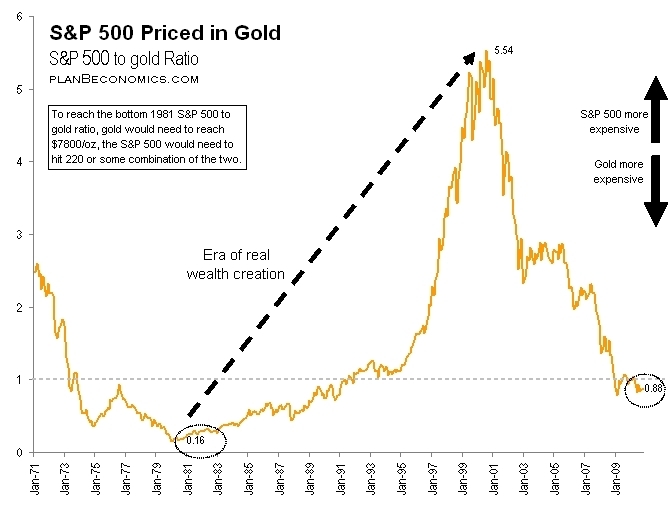
Gold at $7800/oz, Or S&P 500 at 220? Take Your Pick

The chart below shows yet another way to look at the value of the stock market and gold in relation to each other.
The S&P 500 to gold ratio essentially prices the stock market in terms of gold. (Normally, it is priced in terms of dollars. Alternative reference points could include barrels of oil, acres of land or any other thing of value.) This helps provide a way to evaluate the market adjusting for a loss in purchasing power.
A few observations:
  1. The ratio of S&P 500 to gold reached a bottom in 1981 – i.e. gold valuations reached a peak.
  2. Between 1981 and 2000 the stock market rose in real terms.
  3. Between 2000 and present the stock market lost value in real terms.
  4. The S&P 500 to gold ratio has not yet fallen to historical lows. To reach historical lows set in 1981 the S&P 500 would either need to fall to 220, gold would need to rise to $7800/oz or some combination of the two.
click to enlarge
Gold at $7800/oz, Or S&P 500 at 220? Take Your Pick 343576 128925661025543 Plan B Economics

Sunday, November 7, 2010

The Food Crisis Of 2011

Every month, JPMorgan Chase dispatches a researcher to several supermarkets in Virginia. The task is to comparison shop for 31 items.
In July, the firm’s personal shopper came back with a stunning report: Wal-Mart had raised its prices 5.8% during the previous month. More significantly, its prices were approaching the levels of competing stores run by Kroger and Safeway. The “low-price leader” still holds its title, but by a noticeably slimmer margin.

Special Offer: The result of easy money from the Federal Reserve has always been a tsunami of inflation. Don’t let inflation destroy the purchasing power of your dollar-based assets.  Click here for time-sensitive investment information from renowned precious metals and hard asset advisor Curtis Hesler in Professional Timing Service.
Within this tale lie several lessons you can put to work to make money. And it’s best to get started soon, because if you think your grocery bill is already high, you ain’t seen nothing yet. In fact, we could be just one supply shock away from a full-blown food crisis that would make the price spikes of 2008 look like a happy memory.
Fact is,  the food crisis of 2008 never really went away.
True, food riots didn’t break out in poor countries during 2009 and warehouse stores like Costco didn’t ration 20-pound bags of rice…but supply remained tight.
Prices for basic foodstuffs like corn and wheat remain below their 2008 highs. But they’re a lot higher than they were before “the food crisis of 2008” took hold. Here’s what’s happened to some key farm commodities so far in 2010…
  • Corn: Up 63%
  • Wheat: Up 84%
  • Soybeans: Up 24%
  • Sugar: Up 55%
What was a slow and steady increase much of the year has gone into overdrive since late summer. Blame it on two factors…
  • Aug. 5: A failed wheat harvest prompted Russia to ban grain exports through the end of the year. Later in August, the ban was extended through the end of 2011. Drought has wrecked the harvest in Russia, Ukraine and Kazakhstan – home to a quarter of world production
  • Oct. 8: For a second month running, the Agriculture Department cut its forecast for US corn production. The USDA predicts a 3.4% decline from last year. Damage done by Midwestern floods in June was made worse by hot, dry weather in August.
America’s been blessed with year after year of “record harvests,” depending on how you measure it. So when crisis hits elsewhere in the world, the burden of keeping the world fed falls on America’s shoulders.
According to Soren Schroder, CEO of the food conglomerate Bunge North America, US grain production has filled critical gaps in world supply three times in the last five years, including this summer…
  • In 2010, when drought hit Russian wheat
  • In 2009, when drought hit Argentine soybeans
  • In 2007–08, when drought hit Australian wheat
So what happens when those “record harvests” no longer materialize?
In September, the US Department of Agriculture estimated that global grain “carryover stocks” – the amount in the world’s silos and stockpiles when the next harvest begins – totaled 432 million tons.
That translates to 70 days of consumption. A month earlier, it was 71 days. The month before that, 72. At this rate, come next spring, we’ll be down to just 64 days – the figure reached in 2007 that touched off the food crisis of 2008.
But what happens if the U.S. scenario is worse than a “nonrecord” harvest? What if there’s a Russia-scale crop failure here at home?
World Grain Carryover Stocks
“When we have the first serious crop failure, which will happen,” says farm commodity expert Don Coxe, “we will then have a full-blown food crisis” – one far worse than 2008.
Coxe has studied the sector for more than 35 years as a strategist for BMO Financial Group. He says it didn’t have to come to this. “We’ve got a situation where there has been no incentive to allocate significant new capital to agriculture or to develop new technologies to dramatically expand crop output.”
“We’ve got complacency,” he sums up. “So for those reasons, I believe the next food crisis – when it comes – will be a bigger shock than $150 oil.”
A recent report from HSBC isn’t quite so alarming…unless you read between the lines. “World agricultural markets,” it says, “have become so finely balanced between supply and demand that local disruptions can have a major impact on the global prices of the affected commodities and then reverberate throughout the entire food chain.”
That was the story in 2008. It’s becoming the story again now. It may go away in a few weeks or a few months. But it won’t go away for good. It’ll keep coming back…for decades.
There’s nothing you or I can do to change it. So we might as well “hedge” our rising food costs by investing in the very commodities whose prices are rising now…and will keep rising for years to come.
“While investor eyes are focused on the gold price as it touches new highs,” reads a report from Japan’s Nomura Securities, “the acceleration in global food price is unrestrained. We continue to believe that soft commodities will outperform base and precious metals in the future.”
So how do you do it? As recently as 2006, the only way Main Street investors could play the trend was to buy commodity futures. It was complicated. It involved swimming in the same pool with the trading desks of the big commercial banks. And it usually involved buying on margin – that is, borrowing money from the brokerage. If the market went against you, you’d lose even more than your initial investment.
Nowadays, an exchange-traded fund can do the heavy lifting for you, no margin required. The name of the fund is the PowerShares DB Agriculture ETF (DBA).
There are at least a half-dozen ETFs that aim to profit when grain prices rise. We like DBA the best because it’s easy to understand. It’s based on the performance of the Deutsche Bank Agriculture Index, which is composed of the following:
  • Corn 12.5%
  • Soybeans 12.5%
  • Wheat 12.5%
  • Sugar 12.5%
  • Cocoa 11.1%
  • Coffee 11.1%
  • Cotton 2.8%
  • Live Cattle 12.5%
  • Feeder Cattle 4.2%
  • Lean Hogs 8.3%
So you have a mix here of 50% America’s staple crops of corn, beans, wheat and sugar…25% beef and pork…and 25% cocoa, coffee and cotton. It might not be a balanced diet (especially the cotton), but it makes for a good balance of assets within your first foray into “ag” investing.
The meat weighting in here looks especially attractive compared to some of DBA’s competitors, which are more geared to the grains. It takes about six months for higher grain prices to translate to higher cattle and hog prices.
You can capture that potential upside right now…and you’ll be glad you did when you sit down to a good steak dinner a few months down the line. After all, it’s going to cost you more.

Friday, November 5, 2010

Goldman: Real Cost Of Fed “Easing” Will Exceed $2 Trillion

Goldman Sachs anticipates that the real cost of the second round of quantitative easing will be in excess of $2 trillion and will continue well into 2012, while other prominent economists have denounced the Fed’s actions.
The Fed announced yesterday that it would purchase $600 billion in Treasury securities in a statement that left open the possibility of the real cost rising much higher.

“The Committee will regularly review the pace of its securities purchases and the overall size of the asset-purchase program in light of incoming information and will adjust the program as needed to best foster maximum employment and price stability.” the statement read.

As pointed out by Tyler Durden at the Zero Hedge blog, Goldman Sachs has predicted that the real cost of the Fed’s plan will sky rocket.
“We believe that the program will grow significantly beyond the initial $600 billion” remarks Goldman’s Jan Hatzius.

“In practice, QE2 is likely to continue well beyond June 2011–at least well into 2012–if our forecasts for unemployment and inflation are close to the mark. We believe that purchases could ultimately cumulate to around $2 trillion…” she continues.

“Under our longer-term projections it is easy to come up with models that show no tightening until 2015 or later.

In a report last month Hatzius concluded that the projections for QE could reach $4 trillion.
As we reported yesterday, the Fed no longer cares about hiding the fact that it is openly devaluing the dollar and forcing China and other major countries to move away from holding reserves of the currency.

Several prominent economists and even some of the Fed’s own members have warned that the resulting decline in the value of the dollar and rampant inflation could spell disaster for any possible economic recovery.
Meanwhile, influential professor of economics Nouriel Roubini today tweeted that the purchase of debt will continue into a third and fourth round. but will do nothing to revive the real economy:
Goldman: Real Cost Of Fed Easing Will Exceed $2 Trillion 041110QE

Thursday, November 4, 2010

Federal Reserve to print billions of dollars in massive shadow stimulus

The Federal Reserve's policy-setting panel began a crucial two-day meeting Tuesday, poised to cast aside its long-held reluctance to micro-manage the economy in a bid to avoid a lost decade of growth.
The central bank's open market committee (FOMC) is expected to approve massive stimulus spending not seen since the depths of the economic crisis.

At the conclusion of the meeting Wednesday, the Fed is expected to announce it will resume the large-scale purchase of long-term US bonds -- essentially printing billions of dollars -- in the hope of boosting a weak recovery.

While the Fed took similar measures during the crisis, it is unprecedented when the economy is not teetering on the edge of collapse, raising protests from some Fed members who fear it is unnecessary and will fuel long-term inflation.

Critics of the policy argue that although the recovery is painfully slow, markets should be allowed to do their work. They also worry that if the policy fails the Fed's credibility will be wrecked.

"I think that this will quite possibly be the worst mistake by the Fed in a generation," said Stephen Stanley of Pierpont Securities.

But supporters argue that the Fed is failing in both of the prongs of its dual mandate, with unemployment and inflation both at unsustainable levels and must act.

Since Fed chairman Ben Bernanke first suggested the possibility in late September, and confirmed it in October, markets and most economists have penciled in another round of quantitative easing (QE) as a solid bet.
Goldman Sachs analysts and others predicted the rate-setting Federal Open Market Committee would start with a purchase of about 500 billion dollars in Treasury bonds.

The Fed already has poured in more than 1.5 trillion dollars to spark a recovery.

The FOMC meeting opened Tuesday in the thick of hotly contested congressional and local elections nationwide.

President Barack Obama's Democrats are poised to lose seats in Congress to Republicans, who oppose the administration's massive stimulus spending that dragged the economy out of the worst recession since the Great Depression, but ran up sky-high deficits doing it.

A government report Friday showing only modest third-quarter economic growth bolstered expectations of further Fed stimulus to lower long-term interest rates and fight off deflationary pressure in the slack economy.
The world's largest economy grew at a 2.0 percent annual rate in July-September, in line with expectations, slightly more than a 1.7 percent expansion in the second quarter.

Economists consider that economic growth must reach about three percent for some time to significantly reduce high unemployment.

But more than a year after the recession officially ended, unemployment has been hovering near double-digits.
When the government reports payroll data on Friday, the jobless rate was expected to remain stuck at 9.6 percent for the third straight month in October.

"The US economic recovery continues on, but growth remains too weak to cause a serious improvement in the labor market," said Augustine Faucher at Moody's Analytics.

Amid that backdrop the Fed has left interest rates at historic lows and is unlikely to change that stance any time soon.

Nomura Global Economics analysts predicted the FOMC statement would include a commitment to continue buying until the committee's forecasts show significant progress toward full employment and inflation approaches more acceptable levels.