Showing posts with label IMF. Show all posts

Wednesday, December 15, 2010

When Americans Lose Everything, They Start To Lose It

As Gerald Celente has often warned, when Americans lose everything, they will start to lose it, and nowhere was that more apparent than in the case of Clay Duke, the 56-year-old gunman who opened fire on school board members in protest against his wife being fired and his unemployment benefits running out.

Duke spray-painted a V for Vendetta sign on the wall before brandishing a gun and telling everyone apart from the school board members to leave the room. Watch what happened next in the video below.


The response to this tragic series of events from both the establishment left and the establishment right will undoubtedly be to try and portray Duke as a nutcase conspiracy theorist whose views are an example of why free speech on the Internet needs to be curtailed, despite the fact that both on his Facebook page and another website he recommended, Duke promoted websites from across the political spectrum, including Media Matters, who are usually the first to exploit tragic events like these to sling mud at their political adversaries.
The fact that no one was injured and that Duke ultimately claimed his own life has contributed to him becoming a martyr in the Michael Douglas Falling Down mould rather than being considered a deranged lunatic, and Facebook pages in his honor are already attracting members.

Duke was stopped when shots from a security guard wounded him, before he took his own life. Despite the fact that it was a gun that stopped the rampage, Time Magazine and others are already blaming the tragedy on the Second Amendment.

In a de-facto online suicide note posted on Facebook, Duke railed against the financial terrorists that prompted him to take such a drastic course of action
“I was just born poor in a country where the Wealthy manipulate, use, abuse, and economically enslave 95% of the population. Rich Republicans, Rich Democrats… same-same… rich… they take turns fleecing us… our few dollars… pyramiding the wealth for themselves,” he wrote. “The 95%… the us, in US of A, are the neo slaves of the Global South. Our Masters, the Wealthy, do, as they like to us…”

This goes far deeper than someone violently acting upon political grievances. Duke’s actions were solely guided by his economic woes, the fact that his wife had lost her job, that the unemployment benefits had run out, and that the future offered no hope whatsoever.

This is a future that millions more Americans will have to face in the coming years as the unemployment rate, which is really at around the 20 per cent level, continues to accelerate.

As we warned back in June, we are in the early stages of a new “age of rage,” which will be characterized by riots, revolutions and a widespread backlash against the economic holocaust that has been unleashed by the global elite.

Unfortunately there will be many more Clay Dukes over the coming years, there will be more Americans who lose everything and decide that the best way out is simply to lose it altogether.

Wednesday, November 24, 2010

China, Russia quit dollar on bilateral trade

China and Russia have decided to renounce the US dollar and resort to using their own currencies for bilateral trade, Premier Wen Jiabao and his Russian counterpart Vladimir Putin announced late on Tuesday in St. Petersburg.

Chinese experts said the move reflected closer relations between Beijing and Moscow and is not aimed at challenging the dollar, but to protect their domestic economies.

"About trade settlement, we have decided to use our own currencies," Putin said at a joint news conference with Wen in St. Petersburg.

The two countries were accustomed to using other currencies, especially the dollar, for bilateral trade. Since the financial crisis, however, high-ranking officials on both sides began to explore other possibilities.

The yuan has now started trading against the Russian rouble in the Chinese interbank market, while the renminbi will soon be allowed to trade against the rouble in Russia, Putin said.

"That has forged an important step in bilateral trade and it is a result of the consolidated financial systems of world countries," he said.

Putin made his remarks after a meeting with Wen. They also officiated at a signing ceremony for 12 documents, including energy cooperation.

The documents covered cooperation on aviation, railroad construction, customs, protecting intellectual property, culture and a joint communiqu. Details of the documents have yet to be released.

Putin said one of the pacts between the two countries is about the purchase of two nuclear reactors from Russia by China's Tianwan nuclear power plant, the most advanced nuclear power complex in China.

Putin has called for boosting sales of natural resources - Russia's main export - to China, but price has proven to be a sticking point.

Russian Deputy Prime Minister Igor Sechin, who holds sway over Russia's energy sector, said following a meeting with Chinese representatives that Moscow and Beijing are unlikely to agree on the price of Russian gas supplies to China before the middle of next year.

Russia is looking for China to pay prices similar to those Russian gas giant Gazprom charges its European customers, but Beijing wants a discount. The two sides were about $100 per 1,000 cubic meters apart, according to Chinese officials last week.

Wen's trip follows Russian President Dmitry Medvedev's three-day visit to China in September, during which he and President Hu Jintao launched a cross-border pipeline linking the world's biggest energy producer with the largest energy consumer.

Wen said at the press conference that the partnership between Beijing and Moscow has "reached an unprecedented level" and pledged the two countries will "never become each other's enemy".

Over the past year, "our strategic cooperative partnership endured strenuous tests and reached an unprecedented level," Wen said, adding the two nations are now more confident and determined to defend their mutual interests.

"China will firmly follow the path of peaceful development and support the renaissance of Russia as a great power," he said.

"The modernization of China will not affect other countries' interests, while a solid and strong Sino-Russian relationship is in line with the fundamental interests of both countries."

Wen said Beijing is willing to boost cooperation with Moscow in Northeast Asia, Central Asia and the Asia-Pacific region, as well as in major international organizations and on mechanisms in pursuit of a "fair and reasonable new order" in international politics and the economy.

Sun Zhuangzhi, a senior researcher in Central Asian studies at the Chinese Academy of Social Sciences, said the new mode of trade settlement between China and Russia follows a global trend after the financial crisis exposed the faults of a dollar-dominated world financial system.

Pang Zhongying, who specializes in international politics at Renmin University of China, said the proposal is not challenging the dollar, but aimed at avoiding the risks the dollar represents.

Wen arrived in the northern Russian city on Monday evening for a regular meeting between Chinese and Russian heads of government.

He left St. Petersburg for Moscow late on Tuesday and is set to meet with Russian President Dmitry Medvedev on Wednesday.


Source: http://english.peopledaily.com.cn/90001/90778/90859/7208907.html

Tuesday, November 23, 2010

Ireland Is Second Euro Nation to Seek Aid as Banks Wobble

Ireland became the second euro country to seek a rescue as the cost of saving its banks threatened a rerun of the Greek debt crisis that destabilized the currency.

The euro erased gains and Irish bonds pared an early advance after Moody’s Investors Service said a “ multi-notch” downgrade in Ireland’s Aa2 credit rating was “most likely.” The prospect of January elections loomed as the Green Party said it would pull out of Prime Minister Brian Cowen’s coalition.

A package that Goldman Sachs Group Inc. estimates may total 95 billion euros ($130 billion) failed to damp speculation that Portugal and Spain would need to tap the emergency fund set up by the European Union and International Monetary Fund after the Greece rescue.

“It probably won’t halt contagion. The sovereign crisis isn’t yet over,” said Sylvain Broyer, chief euro-region economist at Natixis in Frankfurt. “Ireland is in the middle of a difficult crisis.”

The aid, which Irish officials said as recently as Nov. 15 they didn’t need, marks the latest blow to an economy that more than doubled in the decade ending in 2006. The bursting of the real-estate bubble in 2008 plunged the country into a recession and brought its banks close to collapse. With Irish bond yields near a record high, policy makers are trying to keep the crisis from spreading.

Threat to Euro

“Clearly because of the size of their loan books, the huge risks they took, they became a threat not only to the state but to the” entire euro region, Finance Minister Brian Lenihan told Dublin-based RTE radio in an interview today. “The banks will be downsized to the real needs of the Irish economy” to “Irish consumers and Irish businesses. That has to be the primary focus of Irish banks.”

The euro slid 0.3 percent to $1.3633 at 1:30 p.m. in London. The yield on Irish 10-year notes fell 5 basis points to 8.30 percent after falling as low as 8.11 percent.

The U.K. and Sweden may contribute bilateral loans, the EU said in a statement. Lenihan declined to say how big the package will be, saying that it will be less than 100 billion euros. Goldman Sachs Chief European Economist Erik Nielsen said yesterday the government needs 65 billion euros to fund itself for the next three years and 30 billion euros for the banks.

Deficit, Banks

Talks will focus on the government’s deficit cutting plans and restructuring the banking system, the EU said in a statement. Cowen who spoke at the same press briefing as Lenihan, said the banks will be stress tested. Ireland nationalized Anglo Irish Bank Corp. in 2009 and is preparing to take a majority stake in Allied Irish Banks Plc, the second- largest bank.

Irish banks may get immediate capital injections, Matthew Elderfield, the country’s head of financial regulation, said in a speech today. The country’s two biggest lenders need at least 5 billion euros immediately, Ciaran Callaghan, an analyst with NCB Stockbrokers, wrote in a note to clients on Nov. 18.

The package for Ireland will total as much as 60 percent of gross domestic product, compared with 47 percent for Greece.

Cowen plans to announce the government’s four-year budget plan this week and said an agreement with the EU and the IMF will come “in the next few weeks.”

The Green Party said today it will quit the government after the budget is passed, leaving Cowen without a majority in parliament. Irish voters “feel misled” by the government, leader John Gormley said at a press conference in Dublin.

No ‘Bogeyman’

Irish officials initially resisted pressure from the EU to take any aid, saying they were fully funded until the middle of 2011. European leaders sought to head off contagion from Ireland and reduce pressure on the European Central Bank to prop up the country’s lenders by providing them with unlimited liquidity.
Cowen defended his reversal on the need for aid. “I don’t accept I’m the bogeyman,” he said. “Now circumstances have changed, we’ve changed our policies.”

The bailout follows two years of budget cuts that failed to restore market confidence as the cost of shoring up the financial industry soared.

Lenihan cancelled bond auctions for October and November and announced 6 billion euros of austerity measures for 2011 on Nov. 4 in a bid to restore investor confidence. Those efforts failed after German Chancellor Angela Merkel triggered an investor exodus by saying bondholders should foot some of the bill in any future bailout.

Irish Spread

The risk premium on Ireland’s 10-year debt over German bunds, Europe’s benchmark, fell to 523 basis points today. It widened to a record 652 basis points on Nov. 11, with the yield reaching a record 9.1 percent. In 2007, it cost Ireland less than Germany to borrow. Its 10-year spread then fell to as low as 77 basis points less than bunds. The ISEQ stock index has plunged 70 percent from its record in 2007.
Ireland will draw on the 750-billion-euro fund set up by the EU and IMF in May as part of the Greek bailout to protect the currency shared by 16 countries.

Yields on bonds of Spain and Portugal have jumped amid concern that fallout from Ireland would spread. The extra yield that investors demand to hold Portuguese 10-year bonds instead of German bunds climbed to a record 484 basis points on Nov. 11.

“Speculative actions against Portugal and Spain are not justified, though it can’t be excluded,” Luxembourg Prime Minister Jean-Claude Juncker said today on RTL Luxembourg radio. “In a moment where financial markets have an excessive tendency to punish those countries that didn’t stick 100 percent to an orthodox consolidation, one can never exclude that similar things will happen.”

Source: http://www.bloomberg.com/news/2010-11-22/ireland-seeks-european-union-rescue-as-outsized-crisis-overwhelms-nation.html

Sunday, November 21, 2010

Ireland fears civil unrest as bank crisis deepens

One of Ireland's biggest trade unions warned today that the nation was on the brink of civil unrest as government officials negotiated a multibillion euro bailout for the country's ailing banks.
The Technical Engineering and Electrical Union said further "draconian" public sector cuts of €15bn (£13bn) over four years could lead to street disorder. It urged a campaign of civil disobedience unless the taoiseach, Brian Cowen, calls an immediate election. An emergency cabinet tomorrow will discuss the new round of cuts.

"When the measures being proposed are heaped on top of the €14.5bn cuts already implemented in the last three brutal budgets, life in Ireland will be unbearable," said the TEEU leader, Eamon Devoy. A group of 16 officials from the International Monetary Fund and European Central Bank are staying in Dublin's luxury Merrion hotel, holding talks throughout the weekend with the Irish government and Ireland's central bank. Financial sources told the Observer that a strategy could be announced as soon as Monday to stabilise Ireland's banks.

A first priority is to restore confidence and halt an outflow of cash – Anglo Irish Banks revealed on Friday that customers have withdrawn €13bn of deposits this year. Measures under consideration include hiving off rotten loans into a freestanding "bad bank".

An injection of capital into the banks could be followed by a broader sovereign bailout in the form of a multibillion euro "contingency loan" from the IMF and the ECB. Government sources said the loan would be available for Ireland to draw on if it ran out of money from the beginning of 2011. Asked about any preconditions that might be imposed, one senior source within the ruling Fianna Fail party said: "Because it's a loan that we will have to pay back, they won't be seeking anything major in return like higher corporation tax for Ireland."

Ireland's unusually low 12.5% rate of corporation tax, which has lured investment to the country by multinationals such as Google and Microsoft, is a bone of contention among European leaders. France's president, Nicolas Sarkozy, today said he expected Ireland to increase the tax.

"There are two levers to use: spending and revenues," he said at a Nato summit in Lisbon. "I cannot imagine that our Irish friends [would not use] this because they have a greater margin for manoeuvre than others, their taxes being lower than others."

Ireland's European allies fear that without swift action Ireland's debt crisis could become contagious, weakening confidence in Greece, Portugal, Spain and in the euro as a currency. William Hague, Britain's foreign secretary, expressed uncertainty about the future of the single currency – asked on the Today programme whether he felt the euro could collapse, he said: "I very much hope not. Who knows?"
David Begg, general secretary of the Irish Congress of Trade Unions, said the union movement was calling for mass protests on 27 November to "allow ordinary working people to voice their opposition to a policy that could destroy 90,000 more jobs".

Source: http://www.guardian.co.uk/business/2010/nov/20/ireland-union-devoy-bank-crisis

Friday, November 12, 2010

The Fed Trashes the Dollar

If it is the first responsibility of the Federal Reserve to protect the dollars that Americans earn and save, is it not dereliction of duty for the Fed to pursue a policy to bleed value from those dollars? For that is what Chairman Ben Bernanke is up to with his QE2, or “quantitative easing.”

Translation: The Fed is committed to buy $600 billion in bonds from banks and pay for them by printing money that will then be deposited in those banks. The more dollars that flood into the economy, the less every one of them is worth.

Bernanke is not just risking inflation. He is inducing inflation.

He is reducing the value of the dollar to make U.S. exports more competitive and imports more expensive, so that we will consume fewer imports. He is trying to eliminate the U.S. trade deficit by treating the once universally respected dollar like the peso of a banana republic.

Sarah Palin has nailed cold what Bernanke is about: “We shouldn’t be playing around with inflation. It’s not for nothing Reagan called it ‘as violent as a mugger, as frightening as an armed robber and as deadly as a hit man.’

“The Fed’s pump-priming addiction has got our small businesses running scared and our allies worried. The German finance minister called the Fed’s proposals ‘clueless.’ When Germany, a country that knows a thing or two about the dangers of inflation, warns us to think again, maybe it’s time for Chairman Bernanke to cease and desist.

“We don’t want temporary, artificial economic growth bought at the expense of permanently higher inflation which will erode the value of our incomes and our savings.”

Egging Ben on is the Nobel-prize winning New York Times columnist Paul Krugman. Fed policy is too timid, says Krugman.

When Bernanke said we are not “going to try to raise inflation to a super-normal level,” he blew it, says Krugman, and “there goes the best chance the Fed’s plan might actually work.”

What the Fed should do, he says, is change expectations “by leading people to believe that we will have somewhat above-normal inflation ... which would reduce the incentive to sit on cash.”

But “sit on cash” is a definition of saving. Is saving bad? Once, Americans were taught that saving was a good thing.
Not to Krugman. He wants to panic the public into believing the money they have put into savings accounts and CDs will be rapidly eaten up by Fed-created inflation, so they will run out and spend that money now to get the economy moving again.

Whatever the economics of this, the morality of it is appalling.

Imagine a husband and wife with a bright child who are saving to send the boy to the best prep school, then Princeton, then, hopefully, Harvard or Yale Law, so the boy can realize his dream of being a great lawyer and perhaps one day sitting on the Supreme Court.

Krugman is recommending that the Fed goose the money supply to cause a general fear of inflation, so that couple will run and get their money out of the bank and start spending it, because, if they don’t, their own government will start destroying the value of their savings. This is Weimar economics.

As for inflation, are not the prices of gold, silver, oil and other commodities flashing signals that it is on the way?

In denouncing Bernanke, even the Chinese are not all wrong. They have followed the monetary policy we created at Bretton Woods in 1944, where we tied the dollar to gold at $35 an ounce, while other nations tied their currencies to the dollar at fixed rates of exchange.

China is being denounced for manipulating its currency when Beijing is adhering to a strict dollar-renminbi exchange rate, while our Fed is manipulating the dollar price to seek competitive advantage.

The other Chinese complaint is that they lent us trillions to buy Chinese goods and now we are robbing them by depreciating the dollar-denominated Treasury bonds they accepted in return for their goods.

Pay back your banker in Monopoly money, and you will find you are soon unable to borrow from anyone anywhere.

In four years, the American people have delivered three straight votes of no confidence in the U.S. government. The Fed, however, retains a confidence that it does not deserve, when one considers that, when it was created in 1913, a $20 bill could be exchanged for a $20 gold piece.

Today, it takes seventy $20 bills to buy a $20 gold piece, which means the dollar can buy in 2010 what you could get for 2 pennies in 1910. Quite a record for a central bank set up to protect the dollar.

If Bernanke’s inflation does not generate growth, confidence in the Fed will also vanish. Then a crisis of capitalism will be at hand.

Historians will not deal kindly with the men who traded the horse of U.S. economic nationalism for the rabbit of the Global Economy.

Thursday, November 11, 2010

Will the G-20 Finally Dump the Dollar as the World's Main Reserve Currency?

he Group of 20 (G-20) is meeting today (Thursday) and tomorrow (Friday) in Seoul, South Korea, and one of the main topics of discussion will be the role of the U.S. dollar in the post-crisis global economy.

Debate over the dollar's role as the world's main reserve currency rose to a fevered pitch in 2008 when the financial crisis, which began in the United States, first roiled global markets.

Emerging markets – particularly China, which holds some $2 trillion of foreign reserves – bemoaned the dollar's decline as it drained their dollar-denominated assets of value. Food and energy prices have climbed to record highs, as have many foreign currencies, further exacerbating the issue.

http://moneymorning.com/2010/11/11/g-20-finally-dump-dollar-worlds-main-reserve-currency/

U.S. Debt Proposal Would Cut Social Security, Taxes, Medicare

A plan offered by the leaders of President Barack Obama’s commission to reduce the federal deficit might work. It just won’t happen.

The co-chairmen proposed a $3.8 trillion deficit-cutting plan yesterday that would trim Social Security and Medicare, reduce income-tax rates and eliminate tax breaks including the mortgage-interest deduction. It would reduce the annual deficit from $1.3 trillion this year to about $400 billion by 2015 and start reducing the $13.7 trillion national debt.

“Mathematically it apparently works,” said Stan Collender, a former Democratic House and Senate budget analyst and managing director of Qorvis Communications in Washington. “Politically, it is going to have a lot of trouble getting support from more than just the two co-chairs.”

The plan would raise the gas tax, slash defense spending and farm subsidies and bring down health-care costs by clamping down on medical malpractice suits. The Social Security retirement age would rise to 68 in about 2050 and 69 in about 2075.

Its release created instant opposition from Democrats, some Republicans and groups such as the Mortgage Bankers Association and the Aerospace Industries Association.

Democratic House Speaker Nancy Pelosi called the targeting of Social Security and Medicare “simply unacceptable,” and Republican Representative Jeb Hensarling of Texas expressed opposition to proposals to raise taxes.

Panel co-chairman Erskine Bowles, former chief of staff to President Bill Clinton, joked that he and co-chairman Alan Simpson, a Republican former Wyoming senator, were entering a “witness protection program.”

‘Harpooned Every Whale’

“We have harpooned every whale in the ocean and some of the minnows,” said Simpson, who said the plan is sure to be unpopular. The two said Obama hadn’t seen their plan, which they said should be viewed as a starting point for negotiations. The panel meets again next week to consider proposed changes.

“Is America ready for an adult conversation on the deficit?” said Representative Jim Cooper, a Tennessee Democrat. “It’s ‘put up or shut up’ time.”

None of the proposals would take effect next year to avoid disrupting the economic recovery. The savings would come between 2012 and 2020, cutting the deficit from the current 9 percent of the nation’s gross domestic product to about 2.2 percent in 2015, exceeding Obama’s goal of 3 percent.

$8 Trillion

The government is projected to run $8 trillion in deficits over the next 10 years, which would push the national debt to more than $20 trillion. If the proposal were adopted without change, the government still would have deficits of $350 billion a year.

“It puts out there how big and real the problems are,” said Oklahoma Republican Senator Tom Coburn, a member of the committee.

Under one option, income-tax rates would be reduced to three levels: 8 percent, 14 percent and 23 percent. Now there are six tax levels ranging from 10 percent to 35 percent. The corporate income-tax rate would be cut to 26 percent from 35 percent.

The plan includes two less sweeping alternatives to ending all tax breaks including one in which the mortgage tax deduction would be retained though pared back. Under that proposal, homeowners could not take the break for second homes, mortgages worth more than $500,000 or home equity loans.

Wiping out all tax breaks, including the home mortgage- interest deduction, while lowering rates would cost taxpayers $100 billion a year. Members of the panel could decide to keep some of the breaks by offering offsetting cuts, Bowles said.

‘Not the Time’

John Courson, chief executive officer of the Mortgage Bankers Association in Washington, said eliminating or reducing the mortgage deduction would drive down home values.

“Of all the times to do it, now is not the time,” he said in an interview.

Still, Michael Ettlinger, vice president for economic policy at the Center for American Progress in Washington, said the fact that the deduction disproportionately benefits wealthier homeowners might create political will to revise it.

Overall, yesterday’s proposal would raise taxes by $751 billion over 10 years, including a 15-cent increase in the gas tax that would be phased in starting in 2013. Farm subsidies would be cut by $3 billion a year.

The plan calls for discretionary spending to be cut by $1.4 trillion over 10 years, while mandatory spending -- including Social Security, Medicare for the elderly and Medicaid for the poor -- would be reduced by $733 billion.

John Rother, executive vice president for policy at the senior citizens’ group AARP, said his group would oppose the plan because it would be “dramatically lowering benefits over time” in Social Security and Medicare.

‘Drop Dead’

Bowles and Simpson “just told working Americans to ‘drop dead,’” said AFL-CIO President Richard Trumka. “The very people who want to slash Social Security and Medicare spent this week clamoring for more unpaid Bush tax cuts for millionaires.”

The plan spells out $100 billion in defense cuts, including freezing Defense Department salaries and noncombat military pay at 2011 levels for three years, cutting overseas bases by one- third and doubling proposed cuts in defense contracting.

The Aerospace Industries Association, the trade group for U.S. defense contractors, said it had “grave concerns” about proposals to reduce funds for purchasing, research and development. “We cannot abandon the security of future generations,” said the group, which represents Lockheed Martin Corp., Boeing Co., and Northrop Grumman Corp.

Bowles said about three-quarters of the savings would come from spending cuts, with the remainder from tax increases.

Freeze Federal Salaries

It would reduce congressional and White House budgets by 15 percent, freeze federal salaries for three years and cut the federal workforce by 10 percent. House Republican leader John Boehner of Ohio, who will become speaker in January, said before the plan’s release that he supported a freeze on federal hiring and government workers’ pay.

The proposal would also end government funding of National Public Radio and the Public Broadcasting Service, begin charging fees to visitors to the Smithsonian Institution museums in Washington, raise fees at national parks and merge the Department of Commerce with the Small Business Administration.

It would eliminate the Office of Safe and Drug-Free Schools, whose budget Obama proposed more than doubling from 2008 levels. The plan said that “while school safety should be protected, violence and drug abuse are problems that occur far less on school grounds than elsewhere.”

Agreement Needed

The panel needs agreement from 14 of its 18 members before a plan can be sent for an up-or-down vote in Congress.

White House spokesman Bill Burton said in an e-mail the proposals “are only a step in the process” and that Obama wants to give the panel “space to work on it” without commenting on its details.

Dan Seiver, a finance professor at San Diego State University, said the plan’s strength is its attack on many budget areas long considered untouchable. “You’re not really going to get fiscal sanity without goring everybody -- everybody has to sacrifice,” he said.

Orin Kramer, general partner of hedge fund Boston Provident Partners LP and a Democratic party fund-raiser, said he doubts an agreement can be reached.

“The most central question that somebody should ask is: ‘What are the prospects for a grand bargain that will change the path of federal fiscal policy?’” Kramer said. “And the chances of that under current conditions are zero.”

http://www.bloomberg.com/news/2010-11-10/deficit-reduction-panel-s-plan-would-seek-to-cut-social-security-medicare.html

Tuesday, November 9, 2010

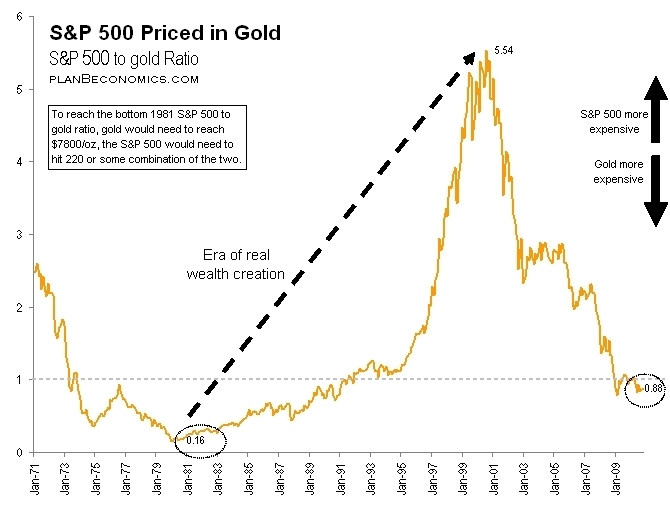
Gold at $7800/oz, Or S&P 500 at 220? Take Your Pick

The chart below shows yet another way to look at the value of the stock market and gold in relation to each other.
The S&P 500 to gold ratio essentially prices the stock market in terms of gold. (Normally, it is priced in terms of dollars. Alternative reference points could include barrels of oil, acres of land or any other thing of value.) This helps provide a way to evaluate the market adjusting for a loss in purchasing power.
A few observations:
  1. The ratio of S&P 500 to gold reached a bottom in 1981 – i.e. gold valuations reached a peak.
  2. Between 1981 and 2000 the stock market rose in real terms.
  3. Between 2000 and present the stock market lost value in real terms.
  4. The S&P 500 to gold ratio has not yet fallen to historical lows. To reach historical lows set in 1981 the S&P 500 would either need to fall to 220, gold would need to rise to $7800/oz or some combination of the two.
click to enlarge
Gold at $7800/oz, Or S&P 500 at 220? Take Your Pick 343576 128925661025543 Plan B Economics

The Feds Biggest Fear

Last week’s decision by the Fed to start another round of Quantitative Easing was met with only one dissenting vote by the Federal Open Market Committee.  That does not mean everybody in the rest of the world thinks this is a good idea.  Any country holding dollars is faced with a decrease in buying power.  Some of the most powerful members of the G-20 are highly critical of the Fed’s money printing.  Germany, Brazil and China all made negative comments about the Fed’s latest round of QE in a Bloomberg article over the weekend.  It reported,

It’s our problem as well if the U.S. is no longer certain that the old recipes don’t work anymore,” German Finance Minister Wolfgang Schaeuble said yesterday in Berlin. The Fed’s injection of $600 billion was “clueless” and won’t revive growth, he said.  Brazil’s central bank president, Henrique Meirelles, said “excess liquidity” in the U.S. economy is creating “risks for everyone.” In China, Vice Foreign Minister Cui Tiankai said “many countries are worried about the impact of the policy on their economies.” He also said the U.S. “owes us some explanation on their decision on quantitative easing.”  

Still, Fed Chief Bernanke is unwavering in the decision to print money to revive the economy.  The same Bloomberg article quoted Mr. Bernanke, “Our first objective, the first goal that we have, is to meet our mandate to get price stability and maximum employment in the United States . . . A strong U.S. economy, a recovering economy, is critical not just for Americans but it’s also critical for the global recovery.”  The rest of the world is clearly not buying the idea that the Fed is saving the world economy.  So what would make the Fed so defiant in the face of such global criticism?  I think the Fed is really worried about mortgage interest rates and declining home prices.  I bring out my favorite updated chart of mortgage resets for adjustable rate mortgages.   The chart below shows a tsunami of resets that will not crescendo until late 2012.   Study it for yourself:
Look at what happened just a day after the Fed announced $75 billion a month of money printing to buy up Treasuries that, in turn, pushed down interest rates.  Frank Nothaft, vice president and chief economist at Freddie Mac, said last week, “With little sign of inflation to push up long-term interest rates, fixed mortgage rates held relatively steady this week, while ARM rates hit new all-time record lows.”


Again, “ARM rates hit new all-time record lows!”  That is precisely what the Fed wants.    Lower rates are what anyone with an adjustable rate mortgage needs.  Lower rates mean lower monthly payments, and that will hopefully keep people in their homes.  And, if homeowners continue paying their mortgages, that will keep trillions of dollars of mortgage-backed securities from becoming even more devalued.  So, the Fed has chosen to support housing prices and let the dollar be damned by printing money.   

John Williams at Shadowstats.com says the Fed’s policies are not helping the economy get better.  The 151,000 jobs that were created in October largely were the result of seasonal-adjustment gimmicks,” according to Williams’ latest report (published last Friday).  If unemployment was computed the way Bureau of Labor Statistics did it before 1994, it would actually be a stunning 22.5% (also, according to shadowstats.com).   


The economy is not getting better–just the opposite, according to Williams, “As the double-dip recession and the federal deficit and related Treasury funding horrors get worse — irrespective of today’s (November 5th) happy report on payroll employment — the Fed’s monetization of Treasury debt will be increased out of necessity, as part of an ongoing effort at systemic salvation.
The Fed wants to support housing prices and, thus, support mortgage bonds.  If those two legs of the housing market are knocked out, the whole economy could come crashing down.  In my mind, that is clearly the Fed’s biggest fear.

Source:  http://usawatchdog.com/the-feds-biggest-fear/#more-2914

Monday, November 8, 2010

Gold Headed for $5,000 an Ounce?

Bob Chapman The whole system is going to collapse

* News * Politics * Welfare Unemployed told: do four weeks of unpaid work or lose your benefits

CONSERVATIVE PARTY CONFERENCE 2010
Iain Duncan Smith wants a new “contract” with the 1.4 million people in Britain on jobseekers’ allowance. Photograph: Geoff Newton/Allstar Picture Library 
 
The unemployed will be ordered to do periods of compulsory full-time work in the community or be stripped of their benefits under controversial American-style plans to slash the number of people without jobs.

The proposals, in a white paper on welfare reform to be unveiled this week, are part of a radical government agenda aimed at cutting the £190bn-a-year welfare bill and breaking what the coalition now calls the "habit of worklessness".

The measures will be announced to parliament by the work and pensions secretary, Iain Duncan Smith, as part of what he will describe as a new "contract" with the 1.4 million people on jobseekers' allowance. The government's side of the bargain will be the promise of a new "universal credit", to replace all existing benefits, that will ensure it always pays to work rather than stay on welfare.

In return, where advisers believe a jobseeker would benefit from experiencing the "habits and routines" of working life, an unemployed person will be told to take up "mandatory work activity" of at least 30 hours a week for a four-week period. If they refuse or fail to complete the programme their jobseeker's allowance payments, currently £50.95 a week for those under 25 and £64.30 for those over 25, could be stopped for at least three months.

The Department for Work and Pensions plans to contract private providers to organise the placements with charities, voluntary organisations and companies. An insider close to the discussions said: "We know there are still some jobseekers who need an extra push to get them into the mindset of being in the working environment and an opportunity to experience that environment.

"This is all about getting them back into a working routine which, in turn, makes them a much more appealing prospect for an employer looking to fill a vacancy, and more confident when they enter the workplace. The goal is to break into the habit of worklessness."

Sanctions – including removal of benefit – currently exist if people refuse to go on training courses or fail to turn up to job interviews, but they are rarely used.

The plans stop short of systems used in the US since the 1990s under which benefits can be "time limited", meaning all payments end after a defined period. But they draw heavily on American attempts to change public attitudes to welfare and to change the perception that welfare is an option for life.

Last night the shadow work and pensions secretary, Douglas Alexander, suggested government policy on job creation was reducing people's chances of finding work: "The Tories have just abolished the future jobs fund, which offered real work and real hope to young people. If you examine the spending review then changes such as cuts to working tax credit are actually removing incentives to get people into work. What they don't seem to get about their welfare agenda is that without work it won't work."

Anne Begg, Labour MP and chair of the Commons select committee for work and pensions, said that many unemployed people already had a work record and carrying out work experience would give them less time to search for a job. "The problem is finding a job," she added. "One of the reasons the last government moved away from work placements and towards things such as the Future Jobs Fund was that it actually acted as a hindrance to them looking for work."

The Observer has also learned that ministers have abolished the Social Exclusion Taskforce, which was based in the Cabinet Office and co-ordinated activity across departments to drive out marginalisation in society. Documents show that the unit has become a part of "Big Society, Policy and Analysis".

Jon Trickett, a shadow minister focusing on social exclusion, reacted angrily, saying that ministers should "hang their heads in shame". Whitehall sources insisted the work would carry on, but more of it would take place in the Department for Work and Pensions.

Naomi Eisenstadt, who was director of the taskforce until last year and is now an academic at Oxford University, said the shift was worrying. "I don't think it is significant in terms of the name – call it a banana – who cares? What does worry me is why they are not using the civil servants who were doing the work on deep disadvantage in the Cabinet Office and exploiting their expertise," she said.

Eisenstadt added that it would be a concern if the government believed the "big society" could take the place of government intervention. "If you speak to any minister I am sure they would agree that civil society is one part of the solution, but not the whole solution," she said.

The proposals come as the government prepares to unveil policy plans across a number of departments. Tomorrow, the Ministry of Justice will reveal that thousands of criminals with serious mental illnesses or drug addictions will no longer be sent to prison but will instead be offered "voluntary" treatment in hospital. Documents will show that offenders will be free to walk away from NHS units because officials believe it would be pointless to create duplicate prisons in the community. "While treatment is voluntary, offenders in these programmes will be expected to engage, be motivated to change and to comply with the tough requirements of their community order," they will say.

Kenneth Clarke, the justice secretary, said: "Serious criminals who pose a threat to the public will always be kept locked up, but in every prison there are also people who ought to be receiving treatment for mental illness rather than housed with other criminals. The public would be better protected if they could receive that treatment in a more suitable setting."

Gold reaching 1400

Will Fed's 600 Billion Jumpstart Economy?

John Boehner Says In Order To Pay For The Wars, We Need To Raise The Social Security Retirement Age To 70

Sunday, November 7, 2010

The Food Crisis Of 2011

Every month, JPMorgan Chase dispatches a researcher to several supermarkets in Virginia. The task is to comparison shop for 31 items.
In July, the firm’s personal shopper came back with a stunning report: Wal-Mart had raised its prices 5.8% during the previous month. More significantly, its prices were approaching the levels of competing stores run by Kroger and Safeway. The “low-price leader” still holds its title, but by a noticeably slimmer margin.

Special Offer: The result of easy money from the Federal Reserve has always been a tsunami of inflation. Don’t let inflation destroy the purchasing power of your dollar-based assets.  Click here for time-sensitive investment information from renowned precious metals and hard asset advisor Curtis Hesler in Professional Timing Service.
Within this tale lie several lessons you can put to work to make money. And it’s best to get started soon, because if you think your grocery bill is already high, you ain’t seen nothing yet. In fact, we could be just one supply shock away from a full-blown food crisis that would make the price spikes of 2008 look like a happy memory.
Fact is,  the food crisis of 2008 never really went away.
True, food riots didn’t break out in poor countries during 2009 and warehouse stores like Costco didn’t ration 20-pound bags of rice…but supply remained tight.
Prices for basic foodstuffs like corn and wheat remain below their 2008 highs. But they’re a lot higher than they were before “the food crisis of 2008” took hold. Here’s what’s happened to some key farm commodities so far in 2010…
  • Corn: Up 63%
  • Wheat: Up 84%
  • Soybeans: Up 24%
  • Sugar: Up 55%
What was a slow and steady increase much of the year has gone into overdrive since late summer. Blame it on two factors…
  • Aug. 5: A failed wheat harvest prompted Russia to ban grain exports through the end of the year. Later in August, the ban was extended through the end of 2011. Drought has wrecked the harvest in Russia, Ukraine and Kazakhstan – home to a quarter of world production
  • Oct. 8: For a second month running, the Agriculture Department cut its forecast for US corn production. The USDA predicts a 3.4% decline from last year. Damage done by Midwestern floods in June was made worse by hot, dry weather in August.
America’s been blessed with year after year of “record harvests,” depending on how you measure it. So when crisis hits elsewhere in the world, the burden of keeping the world fed falls on America’s shoulders.
According to Soren Schroder, CEO of the food conglomerate Bunge North America, US grain production has filled critical gaps in world supply three times in the last five years, including this summer…
  • In 2010, when drought hit Russian wheat
  • In 2009, when drought hit Argentine soybeans
  • In 2007–08, when drought hit Australian wheat
So what happens when those “record harvests” no longer materialize?
In September, the US Department of Agriculture estimated that global grain “carryover stocks” – the amount in the world’s silos and stockpiles when the next harvest begins – totaled 432 million tons.
That translates to 70 days of consumption. A month earlier, it was 71 days. The month before that, 72. At this rate, come next spring, we’ll be down to just 64 days – the figure reached in 2007 that touched off the food crisis of 2008.
But what happens if the U.S. scenario is worse than a “nonrecord” harvest? What if there’s a Russia-scale crop failure here at home?
World Grain Carryover Stocks
“When we have the first serious crop failure, which will happen,” says farm commodity expert Don Coxe, “we will then have a full-blown food crisis” – one far worse than 2008.
Coxe has studied the sector for more than 35 years as a strategist for BMO Financial Group. He says it didn’t have to come to this. “We’ve got a situation where there has been no incentive to allocate significant new capital to agriculture or to develop new technologies to dramatically expand crop output.”
“We’ve got complacency,” he sums up. “So for those reasons, I believe the next food crisis – when it comes – will be a bigger shock than $150 oil.”
A recent report from HSBC isn’t quite so alarming…unless you read between the lines. “World agricultural markets,” it says, “have become so finely balanced between supply and demand that local disruptions can have a major impact on the global prices of the affected commodities and then reverberate throughout the entire food chain.”
That was the story in 2008. It’s becoming the story again now. It may go away in a few weeks or a few months. But it won’t go away for good. It’ll keep coming back…for decades.
There’s nothing you or I can do to change it. So we might as well “hedge” our rising food costs by investing in the very commodities whose prices are rising now…and will keep rising for years to come.
“While investor eyes are focused on the gold price as it touches new highs,” reads a report from Japan’s Nomura Securities, “the acceleration in global food price is unrestrained. We continue to believe that soft commodities will outperform base and precious metals in the future.”
So how do you do it? As recently as 2006, the only way Main Street investors could play the trend was to buy commodity futures. It was complicated. It involved swimming in the same pool with the trading desks of the big commercial banks. And it usually involved buying on margin – that is, borrowing money from the brokerage. If the market went against you, you’d lose even more than your initial investment.
Nowadays, an exchange-traded fund can do the heavy lifting for you, no margin required. The name of the fund is the PowerShares DB Agriculture ETF (DBA).
There are at least a half-dozen ETFs that aim to profit when grain prices rise. We like DBA the best because it’s easy to understand. It’s based on the performance of the Deutsche Bank Agriculture Index, which is composed of the following:
  • Corn 12.5%
  • Soybeans 12.5%
  • Wheat 12.5%
  • Sugar 12.5%
  • Cocoa 11.1%
  • Coffee 11.1%
  • Cotton 2.8%
  • Live Cattle 12.5%
  • Feeder Cattle 4.2%
  • Lean Hogs 8.3%
So you have a mix here of 50% America’s staple crops of corn, beans, wheat and sugar…25% beef and pork…and 25% cocoa, coffee and cotton. It might not be a balanced diet (especially the cotton), but it makes for a good balance of assets within your first foray into “ag” investing.
The meat weighting in here looks especially attractive compared to some of DBA’s competitors, which are more geared to the grains. It takes about six months for higher grain prices to translate to higher cattle and hog prices.
You can capture that potential upside right now…and you’ll be glad you did when you sit down to a good steak dinner a few months down the line. After all, it’s going to cost you more.

Friday, November 5, 2010

Goldman: Real Cost Of Fed “Easing” Will Exceed $2 Trillion

Goldman Sachs anticipates that the real cost of the second round of quantitative easing will be in excess of $2 trillion and will continue well into 2012, while other prominent economists have denounced the Fed’s actions.
The Fed announced yesterday that it would purchase $600 billion in Treasury securities in a statement that left open the possibility of the real cost rising much higher.

“The Committee will regularly review the pace of its securities purchases and the overall size of the asset-purchase program in light of incoming information and will adjust the program as needed to best foster maximum employment and price stability.” the statement read.

As pointed out by Tyler Durden at the Zero Hedge blog, Goldman Sachs has predicted that the real cost of the Fed’s plan will sky rocket.
“We believe that the program will grow significantly beyond the initial $600 billion” remarks Goldman’s Jan Hatzius.

“In practice, QE2 is likely to continue well beyond June 2011–at least well into 2012–if our forecasts for unemployment and inflation are close to the mark. We believe that purchases could ultimately cumulate to around $2 trillion…” she continues.

“Under our longer-term projections it is easy to come up with models that show no tightening until 2015 or later.

In a report last month Hatzius concluded that the projections for QE could reach $4 trillion.
As we reported yesterday, the Fed no longer cares about hiding the fact that it is openly devaluing the dollar and forcing China and other major countries to move away from holding reserves of the currency.

Several prominent economists and even some of the Fed’s own members have warned that the resulting decline in the value of the dollar and rampant inflation could spell disaster for any possible economic recovery.
Meanwhile, influential professor of economics Nouriel Roubini today tweeted that the purchase of debt will continue into a third and fourth round. but will do nothing to revive the real economy:
Goldman: Real Cost Of Fed Easing Will Exceed $2 Trillion 041110QE

Thursday, November 4, 2010

Federal Reserve to print billions of dollars in massive shadow stimulus

The Federal Reserve's policy-setting panel began a crucial two-day meeting Tuesday, poised to cast aside its long-held reluctance to micro-manage the economy in a bid to avoid a lost decade of growth.
The central bank's open market committee (FOMC) is expected to approve massive stimulus spending not seen since the depths of the economic crisis.

At the conclusion of the meeting Wednesday, the Fed is expected to announce it will resume the large-scale purchase of long-term US bonds -- essentially printing billions of dollars -- in the hope of boosting a weak recovery.

While the Fed took similar measures during the crisis, it is unprecedented when the economy is not teetering on the edge of collapse, raising protests from some Fed members who fear it is unnecessary and will fuel long-term inflation.

Critics of the policy argue that although the recovery is painfully slow, markets should be allowed to do their work. They also worry that if the policy fails the Fed's credibility will be wrecked.

"I think that this will quite possibly be the worst mistake by the Fed in a generation," said Stephen Stanley of Pierpont Securities.

But supporters argue that the Fed is failing in both of the prongs of its dual mandate, with unemployment and inflation both at unsustainable levels and must act.

Since Fed chairman Ben Bernanke first suggested the possibility in late September, and confirmed it in October, markets and most economists have penciled in another round of quantitative easing (QE) as a solid bet.
Goldman Sachs analysts and others predicted the rate-setting Federal Open Market Committee would start with a purchase of about 500 billion dollars in Treasury bonds.

The Fed already has poured in more than 1.5 trillion dollars to spark a recovery.

The FOMC meeting opened Tuesday in the thick of hotly contested congressional and local elections nationwide.

President Barack Obama's Democrats are poised to lose seats in Congress to Republicans, who oppose the administration's massive stimulus spending that dragged the economy out of the worst recession since the Great Depression, but ran up sky-high deficits doing it.

A government report Friday showing only modest third-quarter economic growth bolstered expectations of further Fed stimulus to lower long-term interest rates and fight off deflationary pressure in the slack economy.
The world's largest economy grew at a 2.0 percent annual rate in July-September, in line with expectations, slightly more than a 1.7 percent expansion in the second quarter.

Economists consider that economic growth must reach about three percent for some time to significantly reduce high unemployment.

But more than a year after the recession officially ended, unemployment has been hovering near double-digits.
When the government reports payroll data on Friday, the jobless rate was expected to remain stuck at 9.6 percent for the third straight month in October.

"The US economic recovery continues on, but growth remains too weak to cause a serious improvement in the labor market," said Augustine Faucher at Moody's Analytics.

Amid that backdrop the Fed has left interest rates at historic lows and is unlikely to change that stance any time soon.

Nomura Global Economics analysts predicted the FOMC statement would include a commitment to continue buying until the committee's forecasts show significant progress toward full employment and inflation approaches more acceptable levels.

Wednesday, November 3, 2010

The Fed at Jekyll Island: 100 Years Later, They’re Baaack!

Well isn’t this cute?
Just days after the Federal Reserve will announce it has launched QE2, the Fed will hold a major conference at  Jekyll Island, celebrating the secret meeting held 100 years ago that resulted in the creation of the Fed.
The island is off the coast of the U.S. state of Georgia.


In November 1910, Senator Nelson W. Aldrich and Assistant Secretary of the Treasury Department A.P. Andrews, and other top financiers,arrived at the Jekyll Island Club to discuss monetary policy and the banking system. The secret meetings led to the creation of the Federal Reserve.

Forbes magazine founder Bertie Charles Forbes wrote several years later:
Picture a party of the nation’s greatest bankers stealing out of New York on a private railroad car under cover of darkness, stealthily riding hundred of miles South, embarking on a mysterious launch, sneaking onto an island deserted by all but a few servants, living there a full week under such rigid secrecy that the names of not one of them was once mentioned, lest the servants learn the identity and disclose to the world this strangest, most secret expedition in the history of American finance. I am not romancing; I am giving to the world, for the first time, the real story of how the famous Aldrich currency report, the foundation of our new currency system, was written… The utmost secrecy was enjoined upon all. The public must not glean a hint of what was to be done. Senator Aldrich notified each one to go quietly into a private car of which the railroad had received orders to draw up on an unfrequented platform. Off the party set. New York’s ubiquitous reporters had been foiled… Nelson (Aldrich) had confided to Henry, Frank, Paul and Piatt that he was to keep them locked up at Jekyll Island, out of the rest of the world, until they had evolved and compiled a scientific currency system for the United States, the real birth of the present Federal Reserve System, the plan done on Jekyll Island in the conference with Paul, Frank and Henry… Warburg is the link that binds the Aldrich system and the present system together. He more than any one man has made the system possible as a working reality.
EPJ has obtained the agenda of the Fed meeting that will celebrate the 100 year anniversary of the secret meeting.
On November 6 of this year, Federal Reserve Chairman Ben Bernanke will speak on ‘Federal Reserve: Past and Present’ before the ‘A Return to Jekyll Island: The Origins, History, and Future of the Federal Reserve’ conference hosted by the Federal Reserve Bank of Atlanta at the Jekll Island Club Hotel.
The conference opens a day earlier on Friday, November 5, when Federal Reserve Bank of Atlanta President Dennis Lockhart gives welcome remarks.
Also at the conference:
Federal Reserve Bank of Philadelphia President Charles Plosser will moderate a discussion of a paper, ‘To Establish a More Effective Supervision of Banking: How the Birth of the Fed Altered Bank Supervision’
Federal Reserve Bank of Cleveland President Sandra Pianalto will moderate a discussion of a paper, ‘The Promise and Performance of the Federal Reserve as Lender of Last Resort 1914-1933′.
Federal Reserve Bank of Dallas President Richard Fisher will moderate a discussion of a paper, ‘Where It All Began: International Trade, the Market for Acceptances, and the Making of Lending of Last Resort in Britain’
Fresh food that lasts from eFoods Direct (Ad)
Federal Reserve Bank of St. Louis President James Bullard will moderate a discussion of a paper, ‘From Passing Legislation to Building an Institution: Perspectives on the Early Years of the Federal Reserve System’
Federal Reserve Bank of St. Louis President James Bullard will moderate a discussion of a paper, ‘The Fed from the Treasury-Fed Accord (1951) until the End of Monetary Targeting (1982)’.
Federal Reserve Bank of Richmond President Jeffrey Lacker will moderate a discussion of a paper, ‘The Recent Financial Turmoil: New Directions for Monetary Policy Analysis’.
Federal Reserve Bank of Chicago President Charles Evans will moderate a panel on ‘The Role of Research in Monetary Policy Deliberations’.
Federal Reserve Bank of Minneapolis President Narayana Kocherlakota will speak on ‘Policy and Asset Bubbles’.
Needless to say, nothing good can come out of a conference of Fed members talking to each other after just launching QE2 and who will be “inspired” by the historic Jekyll Island location and the 100 year celebration.
Given that the current Fed chairman loves new “tools” by which to inflate the currency and that the conference will be about discussing new tools and old, these guys will be re-enforcing each others mad thinking that they can micro-manage the economy without creating dangerously high inflation. They will think that they were not directly responsible for the recent boom-bust cycle,even though Alan Greenspan created it with his mad money printing..

Tuesday, November 2, 2010

QE2 Is Not A Recovery Plan, It’s A Stealthy Scheme To Prepare For The Next Bank Bailout

I’ve shown in rather elaborate detail in recent weeks that quantitative easing does not help the real economy generate a sustained recovery. This can be summed up as follows:
“QE’s effect on raising aggregate demand and prices was often limited” (Ugai, 2006)
  • QE has been shown to have had little to no impact in the U.K. (also see here).
  • While QE worked to ease the strains in the credit markets in 2008 and also improved bank balance sheets there was no change in interest rates during the entirety of the program in the USA and borrowing has remained very weak.
  • Because the US has a demand side problem and not a supply side problem QE is unlikely to result in higher aggregate demand and revenues (see here).
  • QE is likely to negatively impact corporate margins as investors falsely interpret QE as “money printing” and seek the safety of hard assets (see here).
  • The “wealth effect” of QE is likely to fail. Attempts to keep asset prices “higher than they otherwise would be” will always fail (see here).
  • Since QE has been shown to have no discernible long-term impact on interest rates or aggregate demand there is no fundamental reason for stocks to move higher due to the program (see here).
All of my work regarding QE has me wondering why the Fed would implement such a policy when the evidence appears to point to little to no gain in economic growth? The only logical answer is that QE2 is really just another case of the Federal Reserve proving that this is a country centered around the bankers, by the bankers and for the bankers. Before you brush me off as some conspiracy theorist please consider the evidence.
The problem with a policy like QE is that it does not actually add net new financial assets to the private sector. This is ultimately the primary misconception regarding QE. The expansion of the monetary base is not net new money in your pockets. Thus, it will not help finance new spending or investment, it will not create jobs, it will not increase aggregate demand, etc. Therefore, any policy effectiveness is based on a shuffling of assets and hopes for a sustained psychological change. A sitting member of the FOMC has (finally) admitted that QE is unlikely to do anything for the economy:
“What is the ultimate impact on the overall economy of this shift in risk? In the baseline models used by central banks, all bondholders are taxpayers. In these models, QE is essentially shifting risk from one pocket to another. As a result, the increase in tax risk (what I’m calling the fourth effect of QE) completely undoes the decrease in interest rate risk (the third effect of QE). QE ends up having no effects, except for those associated with any new forward guidance that it signals.”

But there is one distinct benefit of such a policy – it alters the composition of bank balance sheets. At the end of the day it’s really just an asset swap and a transfer of risk via bond duration or bond type. The kicker here, is that if you’re a bad bank with a few trillion dollars in bad mortgage paper you’re delighted if a AAA rated entity comes in and swaps those assets out with their highly rated paper. This is exactly what the Fed did in 2009 and make no mistake – it was hugely successful in clearing the credit markets and altering the
composition of bank balance sheets. This was Mr. Bernanke’s goal after all. He was simply trying to clear the credit markets and improve the banking system and he believed that would ultimately fix the problems in the US economy. Unfortunately, he misdiagnosed a household balance sheet recession as a banking crisis. QE1 provided liquidity in the credit markets and it gave the banks some much needed breathing room. Unfortunately, the impact on the real economy was far more muted.

I think Ben Bernanke knows all of this. He has added $1T in reserves to the banks already and it hasn’t resulted in a surge in borrowing or self sustaining economy recovery. It doesn’t take a genius to understand that adding another trillion won’t change anything either. If there is low demand for apples putting more apples on the shelves does not improve the apples salesman’s ability to sell more apples.

But Mr. Bernanke is seeing the same thing that I am seeing. He sees a weak economy and a housing market that appears to be rolling over again. Knowing that the banks are extremely fragile here and understanding that there is absolutely no political will for another bailout Mr. Bernanke is creating his own bailout by bypassing Congress.


Some of my colleagues say I am giving Mr. Bernanke far too much credit here. After all, this would require a great deal of foresight and a level of proactivity that hasn’t really been a trademark of his in recent years. I am not so certain. In fact, I don’t doubt for one second that Mr. Bernanke is fully prepared to do whatever he must to avoid another bank meltdown. He continues to believe that this is a supply side problem and not a demand side problem. He may have failed in his mandate of full employment, but when it comes to the banking sector Mr. Bernanke is more than accommodative.

What’s unfortunate in all of this is that the policy is being sold to the American public as if it’s a Main Street stimulant. There is, arguably, some merit in doing what Mr. Bernanke is doing. After all, another bank meltdown would be truly traumatic (though probably necessary). So, there’s an argument in favor of being prepared. But selling it as another Main Street stimulant is disingenuous at best. And unfortunately, 99.9% of the public is too oblivious to:
1. Understand QE
2. Raise a fuss.
The implications are obvious. The Fed will likely start with a rather small round of QE this week. After all, if I am correct Mr. Bernanke doesn’t want to unload all of his shells too early. He wants to be fully prepared in case the banks relapse so he can step in with a sizable bank bailout. So, don’t be one bit surprised this week when Mr. Bernanke announces a small round of Treasury purchases with the option to buy MBS in the future. In all likelihood, this program will remain open until it’s clear that the U.S. economy is sustaining recovery and another bank meltdown is off the table. Don’t be fooled into thinking that this is some economic panacea. Unless of course, you’re a banker.